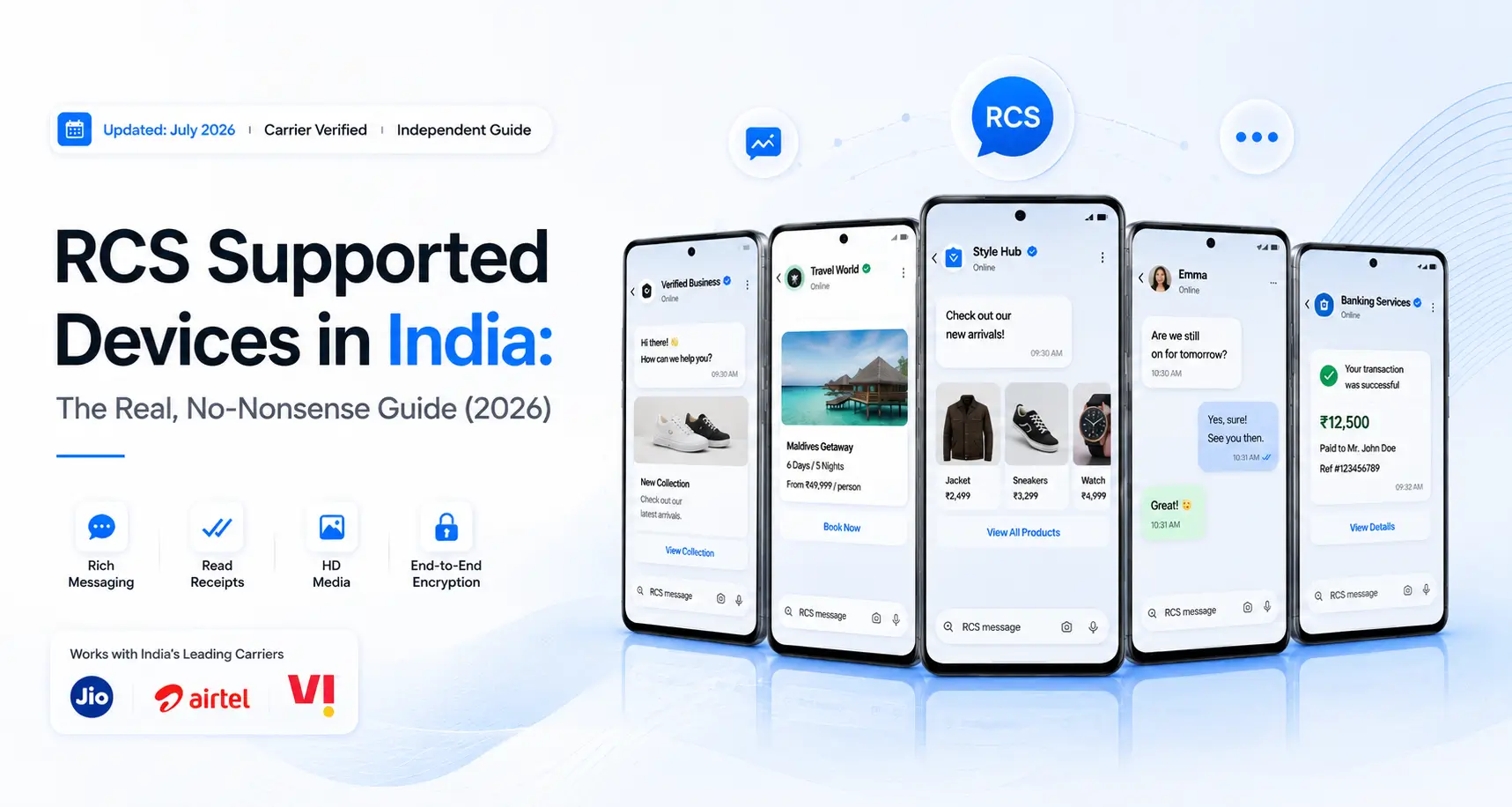
Your customer's messaging inbox used to be simple: SMS in, SMS out, 160 characters, that's it. But today, as of 2026, around 65-70% of Indian smartphone users are RCS-capable in 2026.
Here's the situation. Your customers' phones have quietly upgraded. Their messaging app now supports images, buttons, read receipts, and branded senders, and most of them don't even know the term for it. They just know their texts look nicer than they used to. For the broader RCS service overview, visit RCS Messaging India and the coverage guide at RCS Coverage India 2026.
That term is RCS. And if you're running any kind of customer communication in India, OTPs, order updates, offers, appointment reminders, you need to know exactly which of your customers can receive it, on which phone, on which network. Not "roughly." Exactly.
Wait, What Is RCS, Again?
RCS — Rich Communication Services — is the messaging industry's long-overdue answer to a very old problem: SMS is ugly, limited, and hasn't meaningfully changed since pagers were a thing. RCS lives inside the same default messaging app your customers already have open, but it adds:
- High-resolution photos and videos, not the pixelated mess MMS gives you
- Read receipts and typing indicators
- Interactive buttons ("Track Order," "Pay Now," "Confirm Appointment")
- Product carousels that customers can swipe through
- A verified sender badge with your business name and logo, instead of a random ten-digit number
- Automatic fallback to plain SMS if the recipient's device or carrier doesn't support it, so you never lose reach
In plain terms: SMS is a postcard. RCS is a proper letter with photos enclosed, sent to the same mailbox, at no extra effort for the person receiving it.
Nobody had to install anything. That's the part that should get your attention.
The Gap Instinct: "Android Phones" vs. "iPhones"
Here's a habit of mind worth naming: the tendency to divide the world into two neat, opposing categories. Rich versus poor. Developed versus developing. And, in messaging: iPhone versus "everything else."
The assumption goes like this: iPhones are the advanced, feature-rich devices, and Android is the vast, undifferentiated mass of everything else — old, new, capable, incapable, all lumped together. If you think this way about RCS in India, you will misjudge your audience badly, because the real story is almost the opposite.
Android is not a single category. It is a range. And on that range, RCS support has moved so far along that treating Android as "the basic option" is now the outdated view, not the informed one.
Let's replace the two-bucket picture with the actual numbers.
Who Is Carrying RCS Today
| Carrier | RCS Support | Subscriber Base | Notes |
|---|---|---|---|
|
Reliance Jio
|
Fully live (Android since 2019; iPhone rollout underway) | 480M+ | The earliest and most aggressive adopter. Also the first Indian carrier to enable RCS for iPhone users, ahead of Airtel and Vi. |
|
Airtel
|
Fully live | 370M+ | Rolled out via its Tanla Platforms partnership, live across 4G/5G subscribers. |
|
Vi (Vodafone Idea)
|
Live, national rollout ongoing | 215M+ | Completed its core rollout in 2021; enterprise RCS Business Messaging is expanding through 2026. |
|
BSNL / MTNL
|
Not supported | — | No official RCS support as of mid-2026. Messages to BSNL/MTNL numbers fall back to SMS. |
Three operators. Over a billion subscribers between them and that's most of the country.
Android: Google Messages Is Doing the Heavy Lifting
On Android, RCS runs almost entirely through the Google Messages app. If a phone has Google Messages installed (and most do — many manufacturers now ship it as the default), and it's on Android 5.0 or later, with an active Jio, Airtel, or Vi SIM, it's RCS-capable. Full stop.
Here's the brand-by-brand reality:
- Google Pixel — every model from the Pixel 3 onward, fully supported. Unsurprising, given who builds the app.
- Samsung — Galaxy S, A, M, and F series on Android 5.0+ are covered. One important wrinkle: Samsung Messages is being phased out for RCS, with support ending by July 2026. Samsung is actively pushing its own users toward Google Messages. If you're building campaigns around Samsung device data, factor that migration in.
- Xiaomi, Redmi, Poco — strong support on most models from 2018 onward.
- OPPO, Vivo, Realme — strong support on most models from 2019 onward.
- OnePlus — solid support, models from 2019 onward.
- Motorola, LG, Nokia (HMD), Sony — generally RCS-capable, though switching to Google Messages manually is sometimes required if the manufacturer's own app is set as default.
Translation for the non-technical reader: if your customer's default texting app isn't Google Messages, they can switch to it in about ten seconds. Most never bother, which is exactly why device-and-app-aware targeting matters more than "is Android popular in India" (it is, obviously).
iPhone: The Late Arrival That Changed Everything
For years, RCS in India was an Android-only story, and Apple was perfectly happy to let it stay that way. Then iOS 18 shipped in September 2024, and Apple quietly joined the party — a genuinely significant moment, because it meant the blue-bubble, green-bubble divide finally started to close.
Here's what an iPhone actually needs to receive RCS in India:
- iOS 18 or later — this generally covers iPhone XS, XS Max, XR, and newer, along with the second-generation iPhone SE and up
- A SIM from Jio, Airtel, or Vi — BSNL and MTNL iPhones are, again, left out
- RCS Messaging turned on under Settings → Apps → Messages
And here's the twist worth knowing if you're planning a campaign right now: Jio was the first Indian carrier to actually flip this switch, quietly enabling RCS for iPhone users ahead of its competitors — initially for business messaging rather than person-to-person chats. Independent testing found brands were already sending RCS-flagged promotional messages to iPhone users on Jio's network, complete with rich formatting, well before Airtel and Vi caught up. Airtel and Vi have since confirmed support for iPhone users too, verified through Apple's own carrier lists for the region.
So yes — iPhone users in India can now receive your RCS campaigns. Just don't assume every iPhone user can, and definitely don't assume it works the same way it does on Android (iPhone-to-iPhone conversations still default to iMessage, not RCS — RCS is filling the gap for Android-to-iPhone and business-to-consumer messaging specifically).
Quick gut check: Do you actually know what percentage of your customer list can receive RCS today, versus what falls back to SMS?
If the honest answer is "no idea," then let's fix it before your next campaign, not after.
Talk to MetaReach about a free RCS readiness check →So, How Many Indians Can Actually Receive RCS? (The Numbers)
Let's do some real talk about scale, because "RCS is big in India" means nothing without a number attached.
- Android users on Jio, Airtel, or Vi with Google Messages: roughly 60% of mobile users
- iPhone users on iOS 18+ with a supporting carrier: roughly 7–8% of mobile users
- Total RCS-capable audience: approximately 65–70% of active smartphone users in India — somewhere around 70–80 crore devices
Here's the sentence that should matter most to you as a marketer: for every 10 messages you send, roughly 6 or 7 land as a full, rich, interactive RCS experience — carousels, buttons, images, the works. The other 3 or 4 fall back automatically to plain SMS. Nobody's left out. Nobody bounces. You get the upside of rich messaging with the safety net of universal reach.
India and China together already account for close to a third of all RCS messages sent globally. This is not a niche experiment anymore. It's infrastructure.
What This Actually Means If You Run a Business
We're not going to pretend this is purely academic. If you're sending customer messages in India today — OTPs, delivery updates, EMI reminders, admission notifications, property listings, appointment confirmations — you're already paying for reach. RCS lets you get more out of every message you were going to send anyway.
A few numbers worth sitting with: Indian brands running RCS campaigns are seeing click-through rates roughly 3 to 7 times higher than plain SMS. Read receipts alone change how support teams operate — no more "did they even see this?" guesswork. And because the sender identity is verified — your logo, your name, not a cryptic ten-digit number — customers trust what they're opening. That matters enormously in a market where SMS spam has trained people to ignore unknown numbers on sight.
Where does this show up in practice?
- Banking and insurance — EMI reminders, policy renewal nudges, and KYC prompts with an actual "Pay Now" or "Renew" button attached, instead of a wall of text
- E-commerce and retail — order tracking, cart recovery, and launch announcements with real product images customers can actually see
- Real estate — property carousels, floor plans, and "Schedule a Visit" replies, sent straight to a phone that never had to download an app
- Travel and hospitality — boarding passes, itinerary changes, and rebooking flows with one-tap actions
- Education — admission updates, result alerts, and counselling reminders that don't get buried in a sea of promotional SMS
A fact worth testing directly, rather than guessing at: if roughly two-thirds of a customer list can already see rich, branded messages and the business is still sending plain text to everyone, what is that costing in engagement?
See MetaReach's RCS Business Messaging platform →The Part Nobody Wants to Admit: RCS Isn't Magic
We'd be doing you a disservice if we just told you RCS solves everything and left it there. It doesn't. A few honest realities:
- Not every device behaves identically. Ecosystem maturity varies by operator, device age, and even region. Fallback to SMS exists precisely because this isn't yet universal.
- Most users don't know the word "RCS." They just notice their messages look better. That's fine for adoption, but it means your analytics need context — a spike in engagement might be entirely RCS-driven, and you'd never know it from the raw numbers alone.
- Sending plain SMS-style copy inside an RCS layout is the single most common mistake we see. If you're not using the carousel, the buttons, the rich media — you're paying for a premium channel and using it like a cheap one. That's not a technology problem. That's a creative discipline problem, and it's entirely on you to fix.
- Google brand verification is still mandatory. RCS Business Messaging in India runs on Google's brand verification system, not TRAI's DLT rules — TRAI has no regulatory role over RCS. If your business identity and templates aren't verified with Google, none of this matters yet.
None of this should scare you off. It should just stop you from treating RCS like a magic switch you flip once and forget.
Running SMS alongside RCS? Read our complete DLT registration guide →
How to Check If a Device Is RCS-Ready (Send This to Your Team)
Genuinely useful, five-minute checks. Worth bookmarking.
On Android (Google Messages):
- Open Google Messages
- Tap the profile icon → Messages settings → RCS chats (sometimes labeled "Chat features")
- If there's an "Enable RCS chats" toggle showing "Connected," that device is good to go
On iPhone:
- Confirm the device is running iOS 18 or later
- Go to Settings → Apps → Messages
- Look for "RCS Messaging" and switch it on
- Confirm the SIM is Jio, Airtel, or Vi — if the setting doesn't appear at all, the carrier or device isn't there yet
Most messaging vendors can't actually report who received the rich version of a message and who fell back to SMS — they just send and hope.
MetaReach's platform reports both, with full delivery tracking either way.
Book a free demo →The Bigger Picture
So here is where the facts leave us. Three carriers covering more than a billion subscribers have RCS live. Most Android brands sold in India carry it. Apple, after years of resistance, joined in 2024, and Jio moved on iPhone support faster than anyone expected. Roughly two-thirds of the country's smartphone users can already receive a rich message today, and that number has only moved in one direction over the past two years: up.
None of this means every problem is solved, or that RCS will keep improving forever without effort on anyone's part — progress is never a straight line guaranteed to continue on its own. But it does mean the confident, fact-based answer to "can my customers actually receive this?" is, for most Indian businesses, already yes. The question left worth asking isn't whether RCS has reached enough of India to matter. It has. The question is what you're going to send them now that it has.
Frequently Asked Questions — RCS Supported Devices India 2026
Ready to See What Your Customer List Looks Like on RCS?
Real numbers, not estimates · RCS Business Messaging across Jio, Airtel & Vi · Automatic SMS fallback built in · Full delivery tracking
Disclaimer: Carrier and device support figures cited (Jio, Airtel, Vi, BSNL, MTNL, Samsung, Google, Apple) are sourced from publicly available information as of mid-2026, including operator announcements, device manufacturer documentation, and industry data on RCS adoption in India. Figures are indicative and subject to change as carriers and manufacturers continue rolling out RCS support. This is an independent guide by MetaReach Marketing and is not endorsed by, affiliated with, or sponsored by any of the mentioned carriers or device manufacturers.
Explore All RCS Messaging Resources
Guides, comparisons, pricing & city coverage — everything about RCS business messaging in India
- RCS Messaging Services India
- RCS for Business — A2P Messaging
- RCS Coverage India 2026
- RCS Messaging Services — Full Guide
- RCS Pricing India 2026
- Is RCS Worth the Cost?
- Top 7 RCS Providers India 2026
- RCS API Integration Guide
- RCS Verified Sender Guide
- Samsung Messages RCS Guide
- TRAI DLT Registration Support
Ready to launch your first RCS campaign? MetaReach handles setup end to end — go-live timing depends on brand/agent approval, carrier readiness and your creative or API setup.