
No acronym soup. No vendor spin. Just the practical guide Indian businesses actually need to make the right call on mobile messaging in 2026.

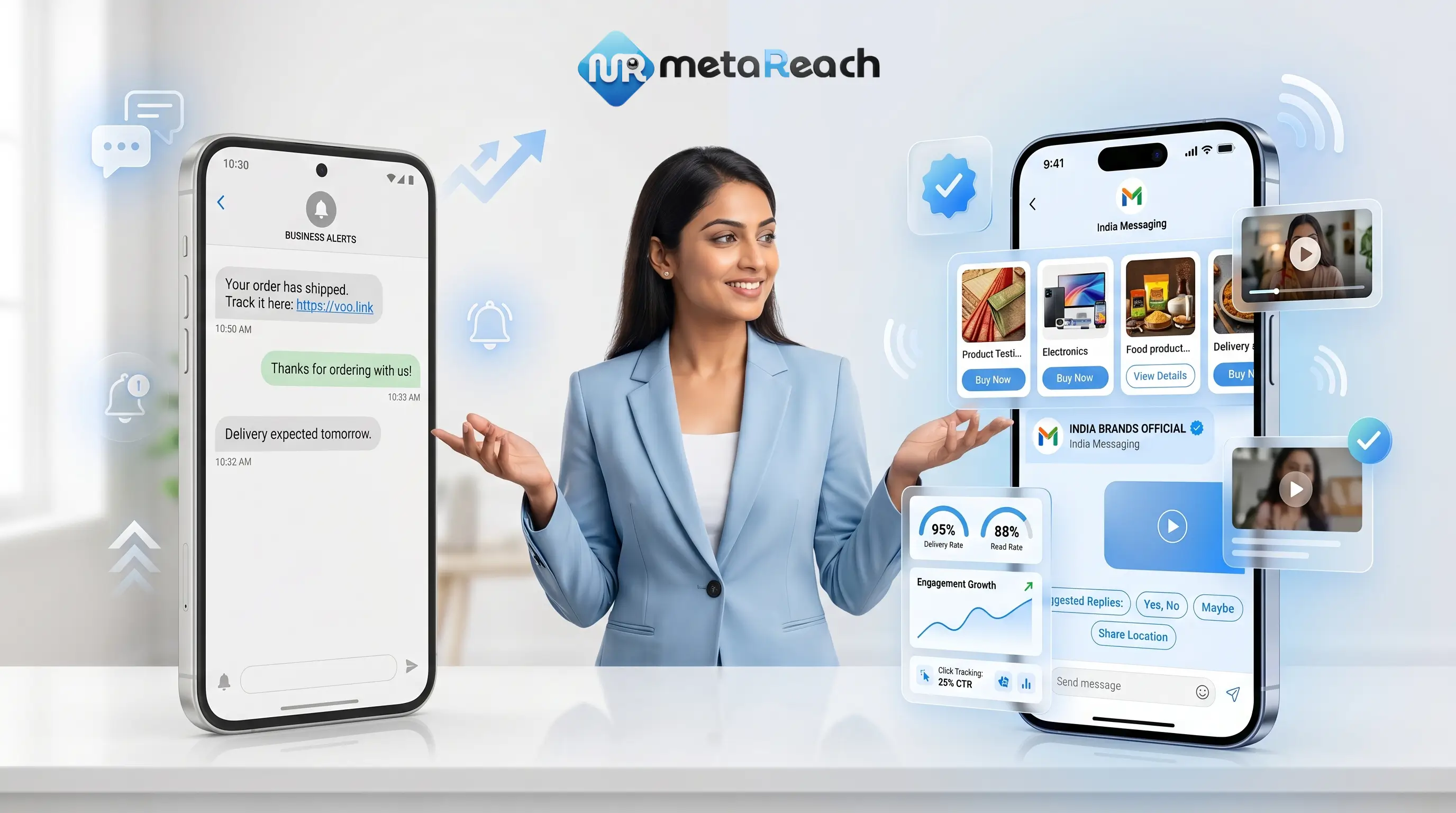
The Short Answer: You don't have to choose between SMS and RCS. The smarter play is to use both — RCS where it works, SMS where it doesn't — and let your platform handle the routing. That's it. That's the strategy.
Still here? Good. Because the why behind that answer is actually worth understanding. Once you do, you'll stop thinking about mobile messaging as a cost line and start thinking about it as one of the most direct conversations you can have with the people who buy from you.
You already know SMS. Everyone does. It's the text message — plain, simple, 160 characters at a time — that lands on your phone whether you have Wi-Fi, whether your phone is a flagship or a decade-old Nokia, whether you're in Delhi or somewhere with barely a single bar of signal.
RCS — Rich Communication Services — is what SMS could look like if it went to design school and came back with opinions about carousels, verified branding, and one-tap buttons.
It runs inside your phone's default messaging app (no extra download required, no separate app icon). On a compatible Android device with mobile data or Wi-Fi, RCS messaging lets brands send images, videos, product carousels, quick-reply chips, and action buttons — all verified with a business name, logo, and brand colours so you know exactly who you're hearing from.
Think of the difference this way: SMS is a postcard. RCS is a beautifully designed direct-mail piece with a perforated reply card already attached. Same channel, same inbox — dramatically different experience.
Here's the side-by-side breakdown most comparison articles never actually give you. Save this table — it answers about half the questions we get from clients every week.
| Feature | SMS (Bulk / A2P) | RCS (Rich Communication Services) |
|---|---|---|
| Content type | Plain text only (160 chars/segment) | Images, video, carousels, rich cards, buttons |
| Device support | Broad device support; delivery depends on network and recipient conditions | Depends on device, messaging app, operator/network, and recipient eligibility |
| Internet required | No — works on cellular signal alone | Yes — needs mobile data or Wi-Fi |
| Open rate (India) | Varies by campaign and audience | Varies by campaign, device, and audience |
| Click-through rate | Varies by campaign and audience | Measure with campaign analytics |
| Branding | Registered sender ID / name | Subject to verification, platform, and configuration |
| Analytics | Delivery reports + tracked link clicks | Available reporting depends on platform and configuration |
| Regulation (India) | TRAI TCCCPR — DLT registration mandatory | Requirements depend on platform, provider, use case, and applicable rules |
| Cost per message | Check current provider rates | Check current carrier and provider rates |
| Best for | Use cases requiring SMS features and eligible recipients | Use cases where supported rich media or actions fit the audience |
| SMS fallback | — | May be configured for eligible workflows where supported |
This is the question that should come before any other question.
SMS? It can reach a broad range of devices without requiring a messaging app or mobile data. Delivery and engagement depend on network, recipient, consent, and campaign conditions.
RCS? Availability depends on the device, messaging app, carrier, and region, and it generally requires mobile data or Wi-Fi. Verify current coverage for your intended audience and configure a suitable fallback where supported.
For any location, check device, messaging-app, operator/network, and recipient eligibility for your actual audience. Do not infer coverage from city alone. SMS fallback may be configured for eligible workflows where supported.
SMS fallback may be configured for eligible workflows where supported. Delivery of either RCS or fallback SMS remains dependent on configuration, recipient eligibility, operator/network conditions, and applicable messaging requirements.
Let's be straightforward here, because this is where a lot of marketing content goes vague.
TRAI regulations mean you're paying for DLT compliance plus per-segment operator fees. Here's what transactional and promotional SMS actually costs in India right now:
| SMS Type | Cost per 160-char Segment | Delivery Window | Best For |
|---|---|---|---|
| Promotional SMS | Check current operator and provider rates | Follow current TRAI and operator requirements | Offers, sales, campaigns |
| Transactional SMS | Check current operator and provider rates | Follow current TRAI and operator requirements | OTPs, order updates, alerts |
| Service (Implicit) SMS | Check current operator and provider rates | Follow current TRAI and operator requirements | Service reminders, renewals |
SMS charges can depend on message length, category, provider, and current operator rates. Confirm applicable charges and segmentation rules with your provider before launching a campaign.
RCS and SMS pricing can vary by carrier, platform, message type, and volume. Compare current rates alongside the outcomes measured in your own campaigns.
Compare cost per delivered message alongside relevant campaign outcomes, such as completed actions or qualified responses. Results depend on audience, message design, eligibility, and implementation; test channels against your own baseline before scaling.
Planning note: Compare current provider quotes and requirements, then evaluate each channel using your own audience eligibility, campaign data, and measured outcomes.
Let's put some benchmarks on the table.
SMS can support broad device reach and does not require a messaging app. Delivery, reading, and response rates vary by recipient, network, content, consent, and timing.
RCS supports rich content and interactive actions on compatible devices and networks. Open, click, and conversion results vary by campaign and audience; use platform analytics and controlled testing to evaluate performance against SMS.
Use campaign data to compare outcomes for your own audience. For businesses evaluating providers, see our RCS messaging provider guide.
For businesses already using WhatsApp marketing alongside bulk SMS, RCS sits in an interesting middle position — richer than SMS, lower barrier than WhatsApp (no app install needed), and operating directly in the phone's default inbox where opt-out friction is minimal. We've covered the full picture in our dedicated guide on RCS vs WhatsApp Business API for businesses weighing both channels in depth.
This isn't the fun part, but it matters more than most guides admit.
For SMS: India's TRAI TCCCPR 2018 framework (and its updates since) is one of the most comprehensive A2P SMS regulatory regimes in the world. Every business sending bulk SMS needs DLT registration, approved sender IDs, approved message templates, and proper consent records. Telecom operators check messages against the DLT ledger in real time — non-compliant messages don't just bounce, they get blocked entirely. Promotional SMS is restricted to 10 AM–9 PM. Transactional alerts (including OTPs) can go anytime. It's a mature system with clear rules.
For RCS: Confirm current platform, provider, consent, opt-out, data-protection, consumer, and sector requirements for the selected workflow. Requirements can change; check current provider and regulator guidance before launch.
RCS and SMS have different capabilities, eligibility conditions, and regulatory requirements. The appropriate channel depends on the intended audience, use case, provider configuration, consent obligations, and current pricing.
Evaluate which workflows fit each channel and whether a supported fallback is needed.
See the SMS vs RCS comparison for channel differences and pricing considerations.
Here's a practical starting point — five steps that work for most Indian businesses:
Step 1: Keep doing SMS for critical alerts
Step 2: Pilot RCS on one high-value journey
Step 3: Build SMS fallback from day one
Step 4: Start your RCS compliance preparation now
Step 5: Think channel-agnostically
The bottom line? You've already got a seat at the table with your customers — every time you send them a message, they've given you a few seconds of their attention. SMS has been a reliable way to honour that for decades. RCS is a chance to do something more interesting with it. Use both. Use them well. And for goodness' sake, don't send a 300-character SMS in three segments when one RCS card with a button would have done the job in half the time.
We set up dual-channel messaging campaigns for Indian businesses across Delhi NCR, Mumbai, Bengaluru and beyond — with full DLT compliance, SMS fallback, and real-time analytics built in.
Talk to Our Messaging TeamRCS and SMS differ in supported content, delivery conditions, and available interaction features. Choose based on audience eligibility, campaign requirements, consent, implementation, and current provider pricing. SMS fallback may be configured for eligible workflows where supported; delivery remains subject to configuration and network conditions.
SMS can reach devices without a messaging app. RCS supports rich media and interactive actions on compatible devices and networks. Availability and engagement depend on audience, carrier, and implementation.
RCS availability and adoption vary by device, messaging app, carrier, and region. Check current coverage information for the intended audience before planning a campaign.
RCS and SMS have different capabilities and delivery conditions. The appropriate channel depends on the intended audience, use case, provider configuration, consent obligations, and current pricing.
There is no single open or click-through rate that applies to every SMS or RCS campaign. Results vary by audience, message relevance, consent, device, and implementation; compare performance using campaign data.
Messaging costs vary by message type, provider, carrier, destination, volume, and current rates. Compare current quotes and total campaign costs, including fallback messaging, before selecting a channel.
DLT requirements apply to SMS as required under applicable rules, including relevant fallback workflows. RCS onboarding and messaging requirements depend on the platform, provider, and use case. Confirm current requirements and applicable consent and opt-out obligations before launch.
SMS fallback may be configured for eligible workflows where supported. Delivery of either RCS or fallback SMS remains dependent on configuration, recipient eligibility, operator/network conditions, and applicable messaging requirements.
RCS and SMS differ in supported content, delivery conditions, and available interaction features. Performance varies by campaign, audience, creative, device/network eligibility, and implementation. SMS fallback may be configured for eligible workflows where supported; delivery remains subject to configuration, recipient eligibility, operator/network conditions, and applicable messaging requirements.
Whether RCS or SMS fits a small business depends on the intended audience, supported devices and networks, use case, implementation requirements, and current provider pricing. Performance varies by campaign and audience.
From startups to enterprises — brands that grow with MetaReach





































Guides, comparisons, pricing & city coverage — everything about RCS business messaging in India
Ready to launch your first RCS campaign? MetaReach handles setup end to end — go-live timing depends on brand/agent approval, carrier readiness and your creative or API setup.