
An honest, no-jargon breakdown of two powerful messaging channels — so you stop guessing and start converting.

Quick Answer: Bulk SMS and RCS differ in supported content, delivery conditions, and eligibility. RCS may support rich media and interactive features on compatible devices and supported messaging apps. Choose based on audience eligibility, campaign requirements, consent, current provider pricing, and implementation. SMS fallback may be configured for eligible workflows where supported.
There's a quiet revolution happening in how Indian businesses talk to their customers.
For over a decade, bulk SMS has been the workhorse of business communication in India. Bank alerts, OTPs, festival offers, appointment reminders — SMS has handled them all, reaching every corner of the country, from Mumbai high-rises to small-town shops in Bihar.
But something new has arrived, and it's turning heads. RCS messaging — Rich Communication Services — is showing up in your customers' Android inboxes with product carousels, real buttons you can tap, branded business logos, and even read receipts. No app download required. It just... appears in their regular messages app.
So naturally, every business owner is asking the same thing: "Is RCS going to replace my SMS campaigns? Should I switch? Which one actually brings in more business?"
That's exactly what this guide breaks down — without the technical jargon, without cherry-picked statistics, and without a hidden agenda to push you toward the expensive option.
Let's get into it.
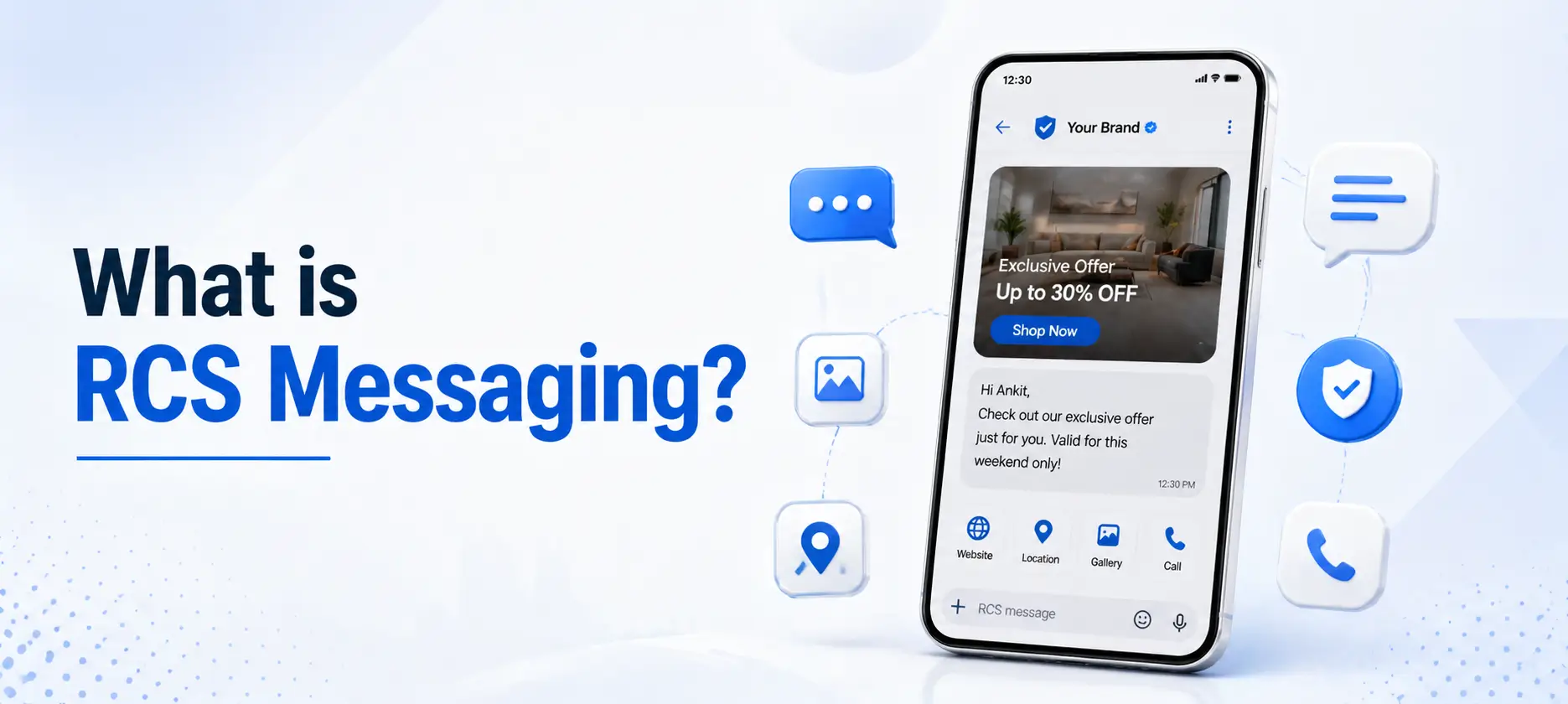
RCS (Rich Communication Services) is a messaging standard that can support rich media and interactive features on eligible devices and supported messaging apps.
RCS stands for Rich Communication Services. The simplest way to think about it is this: imagine if your regular SMS inbox suddenly got the features of WhatsApp. That's essentially what RCS is.
When a business sends you an RCS message, instead of a plain text notification, you get something that looks like a proper message card — with the company's logo, a product image, a description, and tappable buttons that say things like "Book Now", "View Offer", or "Call Us" where supported by the platform and recipient configuration.
For businesses sending RCS in India, the process works through Google's RCS Business Messaging (RBM) platform in partnership with telecom operators. Here's what makes it different from what you're used to with SMS:
That last point — the SMS fallback — is one of the most important features of RCS for Indian businesses, and we'll come back to it.
Pro Tip: RCS is not a separate app. It works through Google Messages — which is the pre-installed default SMS app on most Android phones in India. Your customer doesn't need to download anything. That's what makes RCS genuinely exciting for business messaging.

Before we talk about what RCS can do, let's be honest about why bulk SMS hasn't gone anywhere — and why it probably won't for a very long time in India.
Device types, network conditions, and internet access vary across audiences. Review your recipient data and provider coverage before choosing a channel. Bulk SMS and RCS have different eligibility and content characteristics.
SMS isn't perfect. Here's where it genuinely struggles:
These limitations are precisely the gaps that RCS was designed to fill.
Here's everything laid out side by side so you can make an informed decision:
| Feature | Bulk SMS | RCS Messaging |
|---|---|---|
| Open and response metrics | Varies by campaign | Varies by campaign and eligibility |
| Click-through rate | Varies by campaign | Varies by campaign and implementation |
| Cost per message | Contact provider for current pricing | Contact provider for current pricing |
| Device compatibility | Depends on recipient and network | Depends on device, app, operator/network, and recipient eligibility |
| Connectivity | Depends on channel and network | Depends on device and platform requirements |
| Rich Media Support | Text only (160 characters) | Images, carousels, video, PDFs, buttons |
| Branded Sender ID | Alphanumeric header (e.g., MREACH) | Full brand logo + verified name |
| Interactive Buttons | No | Yes — call, URL, quick reply, location |
| Read Receipts | No | Yes |
| Two-Way Communication | Very limited | Yes — with quick reply buttons |
| SMS Fallback | N/A | SMS fallback may be configured for eligible workflows where supported |
| Regulatory Compliance | TRAI DLT registration mandatory | Requirements depend on platform and provider |
| Setup Time | Depends on provider and configuration | Depends on verification, review, and integration requirements |
| Best For | Use cases aligned with SMS features and requirements | Eligible audiences where supported features fit the use case |
| Average ROI | Varies by campaign | Varies by campaign and audience |
RCS availability and supported features can vary by device, messaging app, operator/network, and recipient eligibility.
Review these requirements before planning a campaign:
iPhone RCS availability depends on iOS version, carrier support, region, and messaging configuration. Available business messaging features may differ by device and operator. Confirm current eligibility before planning an iPhone-specific campaign.
RCS availability and delivery depend on device connectivity, messaging app, operator/network, and recipient eligibility. SMS fallback may be configured for eligible workflows where supported; delivery remains subject to configuration, network conditions, and applicable messaging requirements.
Android RCS availability depends on the specific device, software, messaging app, operator/network, and recipient configuration. Check current eligibility on representative target devices before campaign launch.
RCS and SMS have different content capabilities, eligibility conditions, and requirements. Select a channel based on audience data, use case, consent, implementation, and current provider terms.
Planning note: Verify audience eligibility and configure SMS fallback only where the provider supports the workflow. Delivery of either channel remains subject to configuration, recipient eligibility, and network conditions.
Before selecting campaign volume, check RCS audience coverage and confirm the device, app and business-message eligibility of your intended audience.
Let's move from theory to real examples. Here's how four types of businesses in India are getting the most out of both channels:
A fashion brand in Delhi sends an RCS campaign to its Android customer base with a scrollable carousel of their Diwali collection — each product shows a photo, price, and a "Buy Now" button. Customers who don't have RCS receive a standard SMS with a link to the same collection. The RCS recipients can be compared directly against the SMS group to measure the lift.
A Delhi NCR NBFC sends loan pre-approval notifications via RCS — the message shows the customer's approved amount in a branded card with a "Check Eligibility" button and a "Call Back" option. For feature phone users and non-RCS customers, a standard SMS with a call-to-action link goes out. OTPs and transaction alerts still go via standard SMS for the widest reach.
A Noida builder sends an RCS message with a photo card of a new project, pricing summary, and buttons for "Book Site Visit" and "Download Brochure". The same developer uses bulk SMS for mass reach to 1 lakh contacts during a new launch weekend — because many contacts are outside the RCS-enabled Android base.
A coaching centre in Noida sends RCS messages to parents with a rich card showing the upcoming batch schedule, faculty names, and a "Register Now" button. For the same campaign targeting semi-urban contacts in UP and Bihar, bulk SMS drives the primary outreach — because internet connectivity there is unpredictable.
Here's the honest answer based on your situation:
Let's put actual numbers on the table:
| Item | Bulk SMS | RCS Messaging |
|---|---|---|
| Cost per message | Contact provider for current pricing | Contact provider for current pricing |
| Basic text message | Contact provider for current pricing | Contact provider for current pricing |
| Single rich card (image + button) | N/A | Contact provider for current pricing |
| Carousel (multiple cards) | N/A | Contact provider for current pricing |
| Monthly platform fee | Contact provider for current terms | Contact provider for current terms |
| DLT / Verification (one-time) | Depends on provider and current terms | Review requirements and fees vary by provider |
| Cost to reach 10,000 people | Calculate using current quote | Calculate using current quote |
| Expected CTR | Varies by campaign | Varies by campaign and eligibility |
| Approximate ROI | Varies by campaign | Varies by campaign and audience |
Compare current quotes and total implementation costs with outcomes measured for your own audience. Performance varies by campaign, audience, creative, device/network eligibility, and implementation.
Some businesses evaluate both channels against different audience segments and campaign requirements. Use available eligibility data and current provider terms to plan the channel mix.
Here's what that looks like in practice:
Layer 1 — Mass Awareness (Bulk SMS)
Consider SMS where its content, recipient, consent, registration, and network requirements fit the campaign. Delivery depends on provider and recipient conditions.
Layer 2 — Rich Engagement (RCS)
Consider supported RCS message formats for eligible audiences. Device, messaging-app, operator/network, recipient, and configuration requirements apply.
Layer 3 — Conversion Support (WhatsApp)
Customers who have opted in and meet applicable messaging requirements may receive a follow-up through WhatsApp follow-up — a human or chatbot conversation that answers their questions and closes the deal.
Layer 4 — Retention (SMS + RCS)
Post-purchase messaging should follow applicable consent and channel requirements. Available SMS and RCS formats depend on provider support and recipient eligibility.
This multi-layer approach is what separates businesses that keep growing from the ones that plateau. It's also the exact framework our team at Meta Reach Marketing builds for clients across Delhi NCR.
Planning note: SMS fallback may be configured for eligible workflows where supported. Delivery of either RCS or fallback SMS remains dependent on configuration, recipient eligibility, operator/network conditions, and applicable messaging requirements.
Some businesses get excited about RCS and completely pause their SMS campaigns. This is a costly error. RCS cannot reach your entire audience — feature phone users, iOS users without full RCS support, and customers without internet all get left out. SMS is your safety net. Never abandon it.
RCS Business Messaging has strict anti-spam policies. Sending to contacts who haven't engaged with your business or haven't given consent can result in your brand getting flagged and losing RCS sender privileges. Build your lists organically and respect user consent — it protects your brand long-term.
Follow applicable DLT registration, sender ID, template, consent, and recipient-preference requirements for the SMS use case. Confirm current requirements with your provider before launch.
Message relevance and personalization should be evaluated with your own audience data and controlled campaign testing. Results vary by audience, content, consent, and implementation.
RCS lets you send rich content, but that doesn't mean you should cram everything into one message. Keep RCS cards clean — one primary image, a short punchy headline, and one or two clear action buttons. More choices lead to fewer decisions. Less is genuinely more when it comes to interactive business messaging.
One of RCS's biggest advantages over traditional SMS is the data — open rates, read receipts, button clicks, and conversions are all trackable. Many businesses set up RCS campaigns and never review this data. If you're not tracking performance and A/B testing your messages, you're leaving serious money on the table.
Here's the honest bottom line after everything we've covered.
Bulk SMS and RCS address different messaging needs. Compare current pricing, supported features, audience eligibility, consent requirements, and network conditions for each proposed use case.
RCS may support richer message formats and interactive actions on eligible devices and supported messaging apps. Performance and costs vary by campaign, audience, and implementation.
Choose channels based on the audience and requirements, and configure fallback only where supported. Delivery remains subject to configuration, recipient eligibility, and network conditions.
And if you're not sure where to start — that's what Meta Reach Marketing is here for. Whether you need a bulk SMS campaign, want to explore RCS messaging for your business, or need a fully integrated multi-channel strategy — our team has been doing this for 10+ years across Delhi NCR.
You might also want to read our earlier comparison: WhatsApp Marketing vs Bulk SMS in 2026 — for a deeper look at how WhatsApp fits alongside SMS and RCS in your overall strategy.
Talk to our experts at Meta Reach Marketing — Noida's most trusted bulk SMS, RCS, and WhatsApp marketing partner for 10+ years. Free strategy call, no obligations.
Get a Free Strategy Call
Related RCS Resources
RCS Messaging Services India | RCS for Business India | RCS Coverage in India 2026 | Discuss RCS Requirements
Related Resources
From startups to enterprises — brands that grow with MetaReach






















Guides, comparisons, pricing & city coverage — everything about RCS business messaging in India
Ready to launch your first RCS campaign? MetaReach handles setup end to end — go-live timing depends on brand/agent approval, carrier readiness and your creative or API setup.