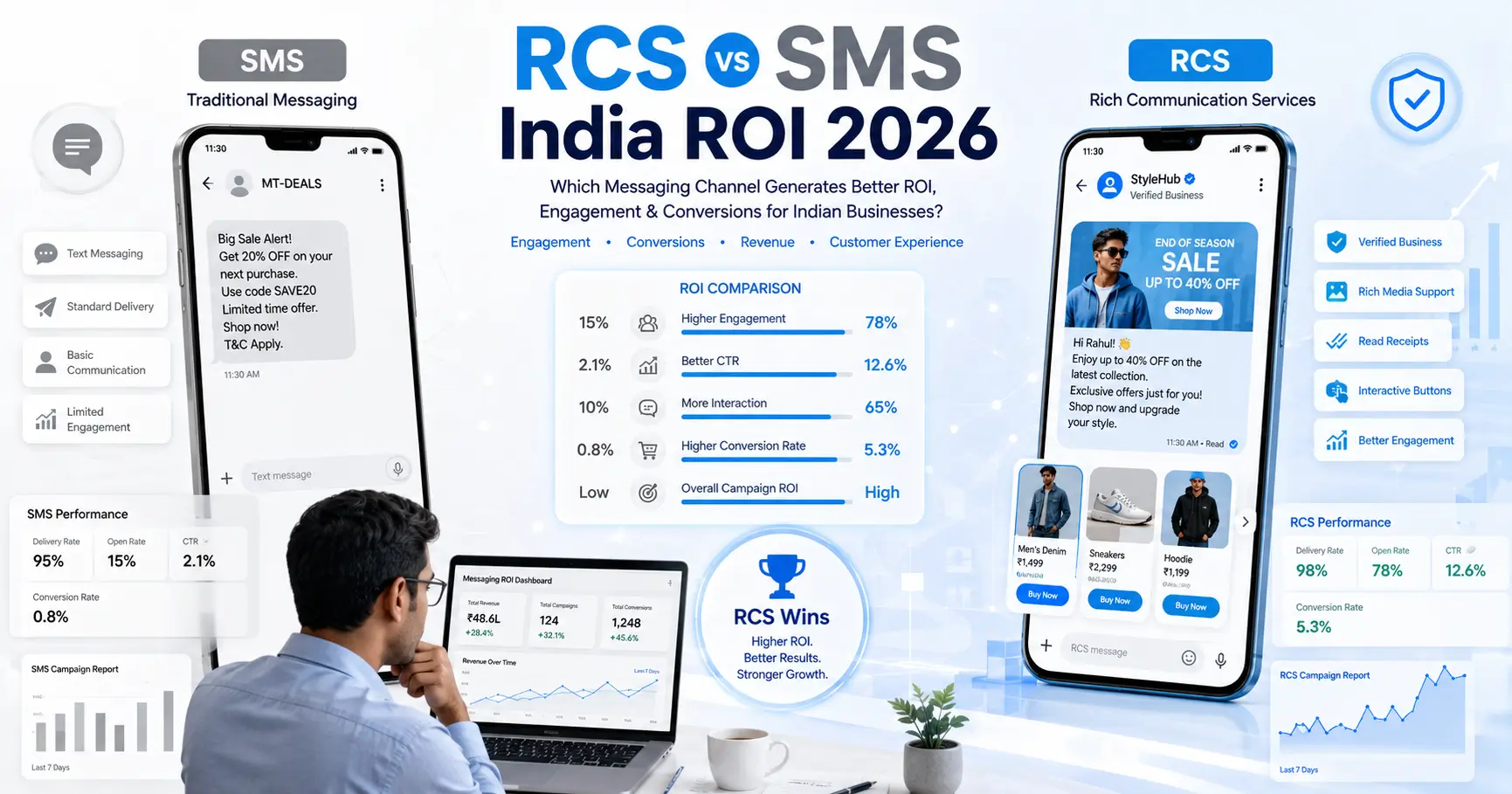
RCS availability depends on device, messaging app, carrier, region, and provider configuration. SMS fallback may extend reach when supported, but no channel assures delivery to every recipient. Verify coverage and test routing for your audience before choosing a deployment approach.
Two years ago, the honest answer to "should we use RCS?" was "not yet." The Android share was high but Apple hadn't adopted RCS, carrier support was patchy, and most bulk SMS platforms hadn't integrated it properly.
That answer has changed. Apple launched RCS support in iOS 18. Jio, Airtel, and Vi all carry RCS traffic. India now has one of the largest RCS-capable audiences on earth. And the engagement data from early adopters is difficult to ignore.
This article gives you the full picture — adoption numbers, a proper ROI comparison, pricing, and a clear decision framework. No hype, no vague claims. Just what actually matters for deciding whether to add RCS messaging for business to your campaigns.
1. What RCS Actually Is (and Isn't)
RCS stands for Rich Communication Services. Think of it as SMS upgraded — it works in the same native messaging inbox on any Android or (now) iPhone, but instead of plain text it supports:
- Verified brand identity — your registered business name, logo, and blue verified checkmark appear as the sender, not a phone number or header code
- Rich media — images, carousels, video, PDFs
- Interactive buttons — reply chips, quick-action buttons, deep links
- Conversational flows — two-way messaging within the same thread
- Read receipts — see when messages are delivered and opened
Crucially: RCS needs no app download. It works in the native messaging app the user already has. This is what separates it from WhatsApp or email campaigns — zero installation friction.
What RCS is not: it is not SMS. It doesn't travel on the cellular SMS channel. It travels over data (Wi-Fi or mobile data). This matters because when a device doesn't support RCS or is offline, the message silently fails unless your platform has SMS fallback enabled.
2. India's RCS Adoption in 2026
RCS availability varies by device, messaging app, carrier, region, and platform configuration. Check current coverage for your own recipient base rather than assuming all smartphone users can receive RCS.
Carrier and platform support can vary and change over time. Confirm availability and fallback behavior with your RCS provider before launching.
SMS fallback may extend campaign reach where it is supported and configured, but it does not assure delivery to every recipient. Test coverage and routing with your provider and audience before relying on fallback.
3. The ROI Comparison: RCS vs SMS
Engagement and conversion results vary by audience, message, industry, consent, device, and implementation. Use your own campaign data to compare channels rather than relying on a universal benchmark.
| Metric | Plain SMS | RCS Business Messaging | Winner |
|---|---|---|---|
| Engagement | Varies by campaign and audience | Varies by campaign, device, and audience | Measure with campaign data |
| Interaction measurement | Use available campaign analytics | Use available campaign analytics | Depends on implementation |
| Click-through rate | ~1–2% | Typically higher than SMS | RCS |
| Conversion rate | Establish a campaign baseline | Measure in a controlled comparison | Depends on campaign |
| Branding | Header code or number | Verified name + logo | RCS |
| Read receipts | None | Yes — open tracking | RCS |
| Cost per message (India) | Check current provider rates | Check current carrier and provider rates | Compare current quotes |
| Delivery | Depends on network and recipient conditions | Depends on device, network, and configuration | Plan fallback where appropriate |
| Regulatory and provider requirements | Follow applicable TRAI/TSP requirements | Confirm current carrier and provider requirements | Check requirements before launch |
| App download by recipient | None | None (native inbox) | Both |
Compare current message rates with the campaign outcomes that matter to your business. Cost per delivered message alone may not reflect total campaign value; use your own audience data and controlled tests to evaluate cost per completed action.
For broad-reach campaigns, compare current provider rates, applicable consent and preference requirements, and the reach available to your audience. See our RCS pricing guide for current pricing considerations.
4. When to Use RCS vs When to Stick with SMS
Use RCS For:
- Cart abandonment recovery
- Product launch + image carousel
- Appointment reminders with Confirm/Cancel buttons
- Loyalty programme offers with CTA buttons
- High-value re-engagement campaigns
- Two-way customer support flows
- Flash sales to warm audiences
- Post-purchase upsell and review requests
Stick with SMS For:
- OTPs and critical alerts where an established fallback strategy is required
- Maximum reach to feature phones and rural areas
- Alerts to users regardless of data connectivity
- Time-critical messages (bank alerts, security notifications)
- Broad awareness campaigns to cold lists
- Any scenario where delivery certainty > engagement
5. RCS vs WhatsApp Business API — A Quick Comparison
Many businesses ask how RCS compares to WhatsApp Business API. They're complementary rather than competing:
- RCS: Works in the native SMS inbox. Consent requirements depend on the message type and Google's RCS Business Messaging policies. Reaches everyone with a compatible handset and data. Branded but without the "WhatsApp" brand association.
- WhatsApp Business API: Requires the customer to have WhatsApp installed and your number saved or a message opt-in. Higher engagement from existing WhatsApp users. Supports rich media, flows, chatbots, and catalogue browsing. Slightly more complex setup and template approval.
For the broadest reach with no app dependency, RCS wins. For deep conversational commerce and markets where WhatsApp penetration is very high (urban India, e-commerce, fintech), WhatsApp API delivers exceptional engagement. Many businesses run both — RCS for reach, WhatsApp for depth.
6. How to Start with RCS in India
Getting started with RCS is simpler than most businesses expect. You don't need a new platform or a separate technology vendor. MetaReach provides RCS Business Messaging as part of the same dashboard you'd use for bulk SMS and WhatsApp — same API, same campaign management interface.
- Brand registration: Submit your business details to the RCS provider. Verification requirements and processing timelines depend on the provider and carrier review.
- Google brand verification: RCS messages don't go through TRAI's DLT process — instead, your business identity, sender name, and logo are verified directly with Google as part of the RCS aggregator onboarding.
- Fallback setup: Configure SMS fallback in your campaign settings. MetaReach handles this automatically — RCS-capable devices receive RCS, others receive SMS.
- First campaign: Start with a well-targeted re-engagement campaign rather than a cold broadcast. RCS's advantages show most clearly when the audience is warm.
For API integration, see our SMS & RCS API documentation, which covers single-endpoint calling for both message types with PHP, Python, Node.js, and Java examples.
7. The Tipping Point: Why 2026 Is Different
In 2022, the case for RCS had too many caveats: iOS exclusion, carrier gaps, limited platform support. In 2026, those caveats are gone:
- Apple iOS 18+ supports RCS — the last major holdout is resolved
- Jio, Airtel, and Vi all carry RCS traffic at scale
- Indian businesses running RCS are publishing measurably better campaign results
- The pricing gap between RCS and SMS has narrowed as volumes have grown
The tipping point for Indian businesses isn't about whether to replace SMS — it's about recognising that a two-channel strategy (RCS with SMS fallback) now gives you better coverage than either channel alone. If you're still running SMS-only campaigns for high-intent audiences, you're leaving measurable engagement on the table.
One important note: RCS without SMS fallback can drop messages for users on poor data connections or non-supported devices. Always ensure your platform has automatic fallback configured. MetaReach enables this by default.
Want to see what RCS has delivered for specific Indian business types? Read our business messaging case studies — we cover D2C retail, fintech, coaching institutes, home services, and B2B manufacturing.
Ready to Test RCS for Your Business?
MetaReach runs RCS Business Messaging campaigns across India with automatic SMS fallback, Google brand verification, and full analytics. Request a demo and we'll show you expected results for your specific use case.
Get Free Demo RCS Messaging Service →