
Everything Indian businesses need to know about transactional SMS — from OTP delivery to DLT compliance, pricing and choosing the right provider.

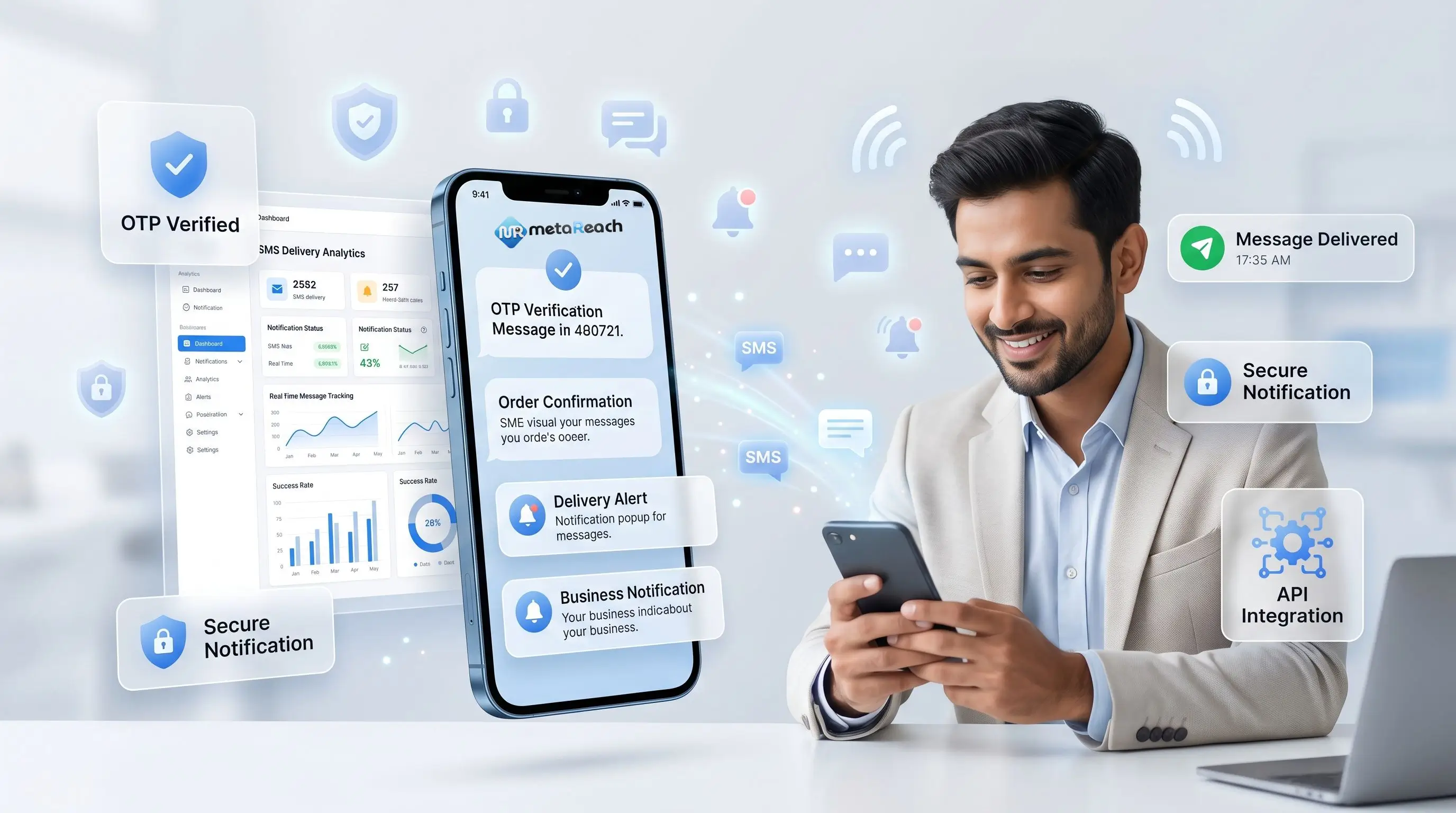
Quick Answer: Transactional SMS in India is a TRAI-regulated message category that delivers critical, non-promotional information to customers — OTPs, order confirmations, payment receipts, appointment reminders, and account alerts. It is not limited to the promotional 9 AM–9 PM window, its DND eligibility depends on the registered category, consent and current TSP/TRAI rules, pricing depends on volume and routing, and it requires DLT registration on a telecom portal.
This complete guide is part of our broader Transactional SMS Service — visit that page for live pricing, API documentation, and integration options.
Every time you receive a "Your OTP is 456321" message or an "Order #78452 has been shipped" alert on your phone, you are receiving a transactional SMS. These messages are the backbone of business communication in India — quiet, reliable, and working in the background every time a customer interacts with a digital product or service.
The Telecom Regulatory Authority of India (TRAI) defines transactional SMS as messages sent by registered business entities to deliver information that a customer has requested or that is essential to a transaction they initiated. This distinguishes them from promotional SMS, which is used for marketing purposes.
In simple terms: if a customer did something — placed an order, logged in, made a payment, booked an appointment — and your system sends them a message about it, that is transactional SMS.
Key Rule: A message is transactional only if it is triggered by a specific customer action or is essential service information. A message saying "Buy our products at 30% off" is promotional — even if it contains a transaction-related phrase. TRAI scrutinises this distinction strictly in 2026.
Indian businesses frequently confuse these two categories, which can lead to non-delivery, TRAI penalties, or DLT rejection. Here is a clear, side-by-side breakdown:
| Feature | Transactional SMS | Promotional SMS |
|---|---|---|
| Purpose | Delivers critical information triggered by user action | Promotes products, services, or offers |
| DND Preferences | Generally not subject to promotional DND preferences when registered under the applicable category | Subject to DND preferences unless consent requirements are met |
| Sending Hours | Not limited to the promotional time window | 9 AM – 9 PM only |
| Sender ID Type | DLT-registered alphanumeric header (e.g., MREACH) | DLT-registered alphanumeric header assigned to the Principal Entity |
| DLT Registration | Mandatory — entity + header + template | Mandatory — entity + header + template |
| TRAI Category | Service Implicit / Service Explicit | Promotional / Telemarketing |
| Typical Cost | Depends on volume and routing | Depends on volume and routing |
| Examples | OTP, order alert, payment receipt | Sale announcements, product launches |
Within transactional SMS, TRAI further categorises messages under the DLT framework into Service Implicit (info arising from an existing customer relationship, like bank alerts) and Service Explicit (service messages sent with the recipient\'s explicit consent, like delivery updates post-purchase). The applicable category depends on your sender/entity type and use case.
The Bottom Line: If you need to send time-critical service messages outside the promotional window, or deliver OTPs reliably — you need a non-promotional (transactional or service) category registered for your entity and use case. Whether a given message can reach a DND-registered number still depends on its category, consent and current TSP/TRAI rules. Promotional bulk SMS cannot do this by law.
Since September 2021, TRAI has mandated that all commercial SMS in India — transactional or promotional — must flow through the DLT (Distributed Ledger Technology) platform. In 2026, enforcement is stricter than ever: unregistered messages are simply not delivered by telecom operators.
Register your business (company, LLP, or proprietorship) on a telecom DLT portal — Airtel, Vodafone-Idea, BSNL, or Jio. This is a one-time, free registration with your GST/PAN documents.
Register the DLT-registered alphanumeric sender ID (header) your messages will appear from (e.g., HDBANK, MREACH, NYKAA). Each header must be linked to your registered entity.
Register each message template you plan to send, marking dynamic variables (like OTP or order number) with {#var#}. Messages that deviate from the registered template are blocked.
Bind your registered entity (PE) to your chosen telecom/messaging provider (TM). Your SMS provider will help you complete this step. Messages from unbound PE-TM pairs are blocked.
Once approved (typically 4 hours with MetaReach), your transactional SMS routes are active. Your provider sends messages through DLT-verified channels and you receive real-time delivery reports.
Pro Tip: If DLT feels overwhelming, a good SMS provider handles the entire registration on your behalf. Meta Reach Marketing's team completes DLT onboarding for clients end-to-end — typically within 4 hours. Learn more about our DLT registration service.
Transactional SMS works across every industry in India. Here are the most impactful use cases in 2026:
Account debit/credit alerts, UPI transaction confirmations, OTPs for net banking and credit card transactions, loan EMI reminders, fixed deposit maturity alerts. Banks send hundreds of millions of transactional SMS per month in India.
Order placed, payment received, order shipped, out-for-delivery, and delivered confirmations. Return pickup scheduling and refund processing updates. eCommerce brands see up to 30% fewer customer support calls with automated transactional SMS.
Appointment confirmation and reminder (24 hrs + 2 hrs before), doctor availability alerts, lab report ready notifications, prescription dispatch alerts from online pharmacies, hospital discharge summaries.
Fee payment receipts, exam admit card dispatch notifications, result declarations, online class joining links (triggered), student admission confirmation letters, and timetable change alerts.
Flight/train/bus ticket booking confirmation with PNR, check-in reminders, hotel booking confirmation, cab booking OTP and driver details, flight delay or cancellation alerts.
Token amount receipt, site visit booking confirmation, EMI due date reminders for under-construction properties, possession date alerts, and documentation requirement reminders.
Policy issuance confirmation, premium due date reminders, claim status updates (submitted, under review, approved, rejected), and renewal reminders 30/7/1 days before expiry.
Order dispatch SMS with tracking link, delivery confirmation, loyalty points earned notification, warranty registration confirmation, and product review request after delivery.
OTP (One-Time Password) SMS is the most critical sub-category of transactional SMS. In India, nearly every digital service — banking apps, UPI platforms, eCommerce logins, insurance portals, and government services — relies on OTP SMS for user authentication and payment authorisation.
What is OTP SMS? OTP SMS is a non-promotional message that delivers a time-limited, single-use numeric or alphanumeric code to verify a user's identity or authorise a transaction. The applicable DLT template category depends on the sender/entity type and use case; registered under the applicable non-promotional category, it is generally not subject to promotional DND preferences or the promotional time window.
Related: OTP SMS service · OTP SMS DLT compliance guide.
Delivery time and success rate vary by operator load, network conditions and handset status, so treat any single figure as indicative. The table below shows how route quality typically compares.
| Provider Quality | Typical Delivery Time | Success Rate |
|---|---|---|
| Premium (Direct telecom routes) | Usually seconds | Highest of the four |
| Standard (Aggregator routes) | Seconds to tens of seconds | Good |
| Economy (Reseller routes) | Can exceed a minute | Variable |
| Poor routing (congested) | Minutes, or failure | Poor |
Transactional SMS is almost always sent via an API (Application Programming Interface) — your website, app, or CRM calls the SMS provider's API when a trigger event occurs (user login, order placed, payment received), and the SMS is dispatched automatically without any manual action.
Step 1 — Trigger Event
A user on your platform completes an action (places an order, enters a login OTP request, makes a payment). Your backend code detects this event.
Step 2 — API Call
Your server sends an HTTPS POST/GET request to the SMS provider's API endpoint with parameters: recipient number, message content, sender ID, DLT template ID, and your API key.
Step 3 — DLT Verification
The SMS provider validates your message against the registered DLT template and entity. If the template matches and the binding is valid, the message is approved.
Step 4 — Telecom Routing
The provider routes the message through direct connections to Indian telecom operators (Airtel, Jio, Vi, BSNL) who deliver it to the recipient's device within seconds.
Step 5 — Delivery Report
The telecom operator sends a delivery receipt back through the provider to your system — confirming whether the message was delivered, failed, or is pending. You can log these in your CRM or dashboard.
Pro Tip: When evaluating a transactional SMS provider, always ask for their API documentation, sandbox/test environment, and sample code in your preferred language. A good provider should have your team integrated and testing within 30 minutes.
Transactional SMS is one of the most cost-effective communication channels in India. Here's MetaReach's 2026 pricing — per-SMS volume slabs, the more you send the lower the rate, plus 18% GST:
| Volume (messages/month) | Price (per SMS) | Monthly Cost Estimate |
|---|---|---|
| 5,000 – 9,999 | ₹0.40 | 5,000 SMS = ₹2,000 + GST |
| 10,000 – 19,999 | ₹0.30 | 10,000 SMS = ₹3,000 + GST |
| 20,000 – 49,999 | ₹0.20 | 25,000 SMS = ₹5,000 + GST |
| 50,000 – 99,999 | ₹0.15 | 50,000 SMS = ₹7,500 + GST |
| 1,00,000 – 5,00,000 | ₹0.12 | 1,00,000 SMS = ₹12,000 + GST |
| Below 5,000 or 5,00,000+ | Custom quote | Custom enterprise pricing |
OTP SMS uses the same volume slabs. See transactional SMS service or contact MetaReach for current rates.
With dozens of SMS providers in India, the choice can be overwhelming. Here are the eight criteria that matter most for transactional SMS — especially if you need reliable OTP delivery:
A provider with direct connections to Airtel, Reliance Jio, Vodafone-Idea (Vi), and BSNL delivers faster, more reliable messages than aggregators routing through intermediaries. Always ask your provider whether they have direct operator ties.
Your provider should offer complete DLT registration assistance — entity registration, header setup, template approval, and PE-TM binding. Avoid providers who leave DLT entirely to you, especially if you are new to SMS compliance.
For transactional SMS, ask for per-message delivery reports and, if you need one, a written SLA that states how uptime and delivery are measured. Be cautious of headline percentages with no stated measurement period or method.
OTP messages need to arrive quickly enough for the user to complete login. Ask for documented proof of average delivery speeds on live traffic — not test environments.
Your system must know immediately whether a message was delivered, failed, or is still in transit. A good provider offers both dashboard reports and webhook-based delivery callbacks to your server.
Evaluate the REST API documentation, sandbox environment, and SDK availability. A developer-friendly API saves your team hours of integration time.
Can the provider handle 10,000 OTPs per minute during a peak event (flash sale, IPO subscription, exam result day)? Enterprise-grade transactional SMS infrastructure matters when your business scales.
Transactional SMS failures are business emergencies. Look for published support hours and dedicated account managers — not just a ticket system that responds in 48 hours.
Meta Reach Marketing provides TRAI/DLT-compliant transactional SMS with real-time delivery reports, priority OTP routing, DLT registration support and API integration. Serving 500+ businesses across India since 2016.
Get a Free Demo & Pricing
From startups to enterprises — brands that grow with MetaReach











































Guides, OTP, transactional, DLT registration & city coverage — everything about bulk SMS in India
Send your first bulk SMS campaign with the right setup and routing for your use case. Contact MetaReach for current commercial terms and onboarding guidance.