
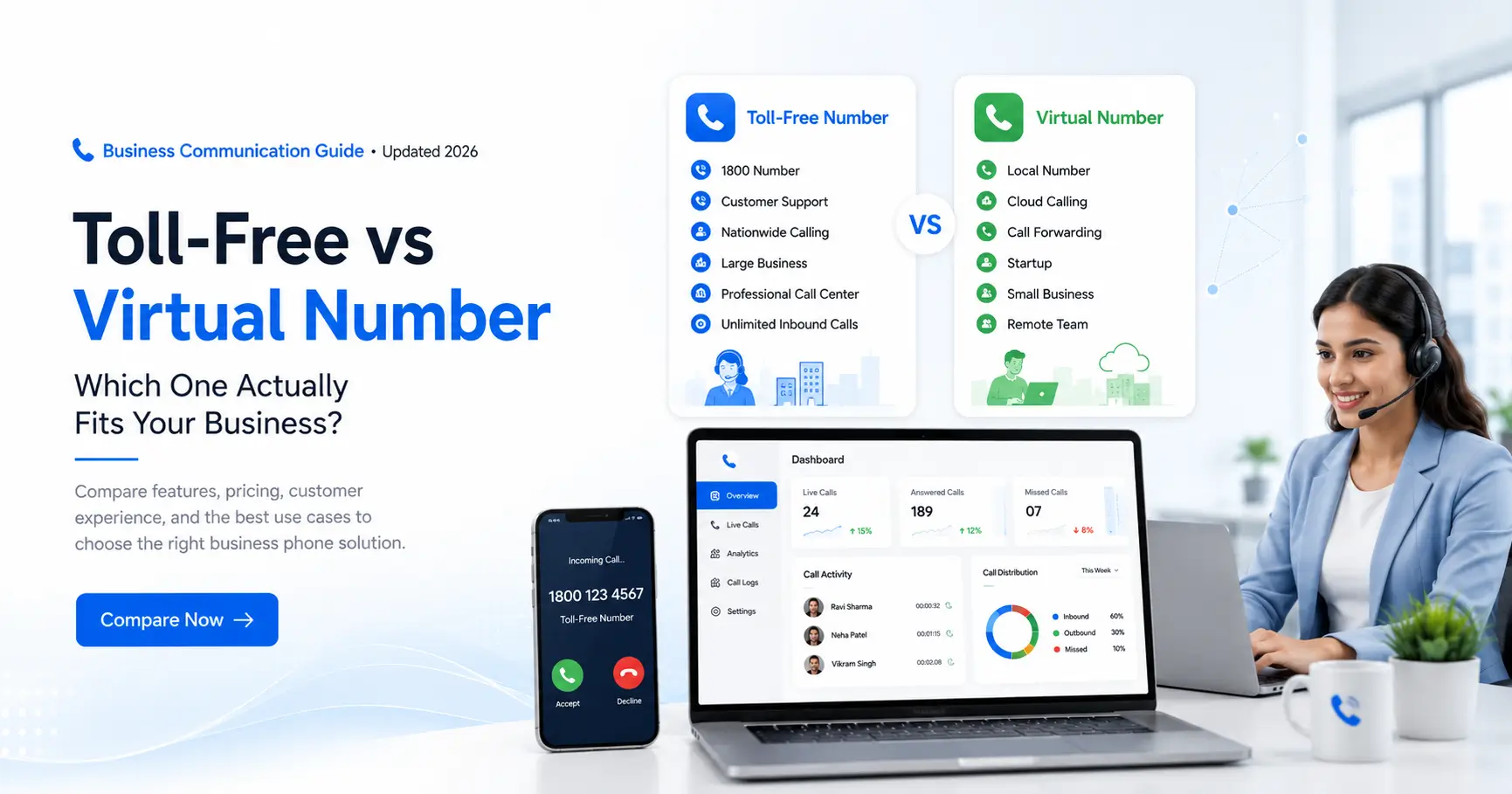
Here's a scene that plays out in a hundred small business WhatsApp groups a week: someone's finally ready to put a phone number on their website, and they ask "toll-free or normal number?", and three people answer with three different opinions, and nobody explains why. So the founder just picks whichever one their cousin's startup used.
That's not really how you should pick a phone number. It's a small decision on paper — you're not signing a lease, you're not hiring anyone — but it's the one thing that shows up on every invoice, every ad, every cold call follow-up you ever make. A number is doing PR for you before you've said a word.
So let's actually sort out what these two things are, and more importantly, when each one earns its keep.
Still running your business off a personal mobile number?
MetaReach Marketing gets you a professional toll-free or IVR-backed line, with real-time delivery reports and
10+ years of experience behind it.
What a virtual number actually is
A virtual number isn't tied to a SIM card sitting in a drawer somewhere. It lives on cloud telephony infrastructure, which is a fancy way of saying calls to it can land wherever you want them to — someone's mobile, a laptop app, an agent in a call center three cities away, or all three ringing at once. Because there's no physical line involved, you can have a number with a Mumbai area code without ever setting foot in Mumbai.
Quick technical aside, because people get this wrong constantly: toll-free numbers are technically a type of virtual number too, since they also run on cloud routing. But when people say "virtual number" in everyday conversation, they mean the local, area-code kind — the one that makes you look like you're already in the neighborhood. That's the version this article is really comparing.
These numbers usually come bundled with the stuff you'd expect — call forwarding, an IVR menu, recording, click-to-call buttons on your site, analytics on who's calling and when. If you're running WhatsApp Business, doing OTP-based logins, or tracking a city-specific ad campaign, a local virtual number tends to be the first thing people reach for, and for good reason — the local footprint and flexible routing do a lot of quiet work together.
What a toll-free number actually is
With a toll-free number, you pay for the call, not the person dialing in. In the US you'll recognize these by their prefixes — 800, 888, 877, 866, 855, 844, 833 — rolled out one after another as the older ones got used up (800 dates back to 1966; 833 only showed up in 2017). In India it's 1800, usually followed by six or seven digits, and it's free for the caller regardless of whether they're on a landline or a mobile. There's also 1860 in India, a slightly different animal — the caller pays local rates and the business eats the long-distance difference.
The whole concept goes back to mail-order catalogs and hotel chains that needed one number the entire country could dial without racking up long-distance charges. And honestly, that DNA is still visible — toll-free numbers were built for reach, not for intimacy.
Setting one up is genuinely boring in the best way. Most VoIP providers let you pick a number off a dashboard in a few minutes, no hardware involved. Expect somewhere around $10–15 a month if it's standalone, or $5–15 if you're tacking it onto an existing multi-user plan.
The difference that actually matters
Everyone gets stuck comparing prefixes and pricing, but the real difference is psychological, not technical. A toll-free number says we're big enough that your call doesn't cost you anything. A local number says we're close enough that we already get you.
Neither message is better. They just point in opposite directions, which is exactly why so many businesses get this choice wrong — they're optimizing for the wrong signal.
Toll-free tends to work when you want to look national and established, when you're running the same ad across multiple markets and want one consistent number, or when your customers are spread across time zones where long-distance cost might quietly talk them out of calling. There's actual research behind this too — a large majority of US consumers associate toll-free numbers with being a higher-quality business, and toll-free ads see noticeably better response rates than ones without.
Local virtual numbers earn their keep in the opposite situation — when you're moving into a new city and want to look like you've already been there a while, when you're running geo-targeted campaigns and need to know which city is actually generating calls, or when two-way SMS matters to you (toll-free numbers can be surprisingly restrictive here). And the local-trust effect is real, not just a vibe — plenty of research shows people are willing to pay more to do business with something that feels local.
Toll-free or local number — which one's right for your business?
MetaReach Marketing sets up 1800 numbers and smart IVR routing in hours, not days.
So which one should you actually pick?
Depends entirely on who's calling and from where.
If you're running a bakery or a clinic that serves one neighborhood, you almost certainly don't need toll-free. A local number costs less and builds more trust with the exact people you're trying to reach — why pay extra to sound like a call center when your whole appeal is that you're five minutes away?
If you're a SaaS company or an e-commerce brand selling across the country, toll-free makes sense as your main line, with local numbers layered in underneath for city-specific campaigns you want to track separately.
Consulting firms and agencies chasing enterprise clients often lean toll-free too — not because it does anything functionally different, but because during a pitch or a cold follow-up, that number is a tiny, almost subconscious signal of scale.
And if you're expanding into a new city before your brand has any recognition there, go local first. People answer numbers that look familiar far more readily than ones they don't recognize, toll-free or not.
A lot of businesses, once they're past the early stage, end up running both — toll-free as the anchor on the website and the invoices, local numbers wired into call-tracking so every campaign's ROI is visible on its own. This isn't some rare edge case. It's becoming the default, actually, especially now that phone calls haven't gone anywhere the way everyone assumed they would. McKinsey's research found live calls are still among the most preferred support channels across every generation, Gen Z included — the group everyone assumes hates phone calls. Most customer care leaders in that same research expect call volume to keep climbing over the next year or two. Which means the number you pick today isn't some legacy decision you'll quietly forget about — it's how people are going to keep reaching you.
And the money part
Toll-free costs more because you're the one absorbing incoming call charges — figure $10–15 a month standalone in the US, $5–15 as an add-on. In India it's more provider-dependent since you're also paying per-minute on top of the subscription. Local numbers are cheaper across the board, since the caller's paying the standard rate, and most providers just throw a few into your base plan anyway.
Don't get too fixated on the sticker price, though. The better question isn't which number costs less — it's which one brings in more calls worth having. A toll-free line that costs a few extra a month but doubles your ad response rate isn't the expensive option. It's the cheap one, once you actually do the math.
Get your toll-free 1800 number live with MetaReach Marketing
TRAI compliant, IVR-ready, trusted by 500+ Indian businesses.
Setting it up, briefly
Pick a provider that has whatever you actually need — WhatsApp integration, IVR, multi-line routing, whatever. Choose your prefix (toll-free gives you a pool to pick from; local means picking the city you want to sound like you're from). Set up your routing — one phone, a rotating team, an IVR tree. Then, before you put that number anywhere near your website or your ad copy, actually call it yourself and sit through the whole thing, hold music included. Long hold times are still one of the biggest sources of customer frustration there is, and a number is only as good as what happens after someone dials it.
Every missed call is a missed customer.
MetaReach's Missed Call and Click-to-Call services make sure no lead slips through
— set it up before your next campaign goes live.
Toll-Free Number vs. Virtual Number: Feature-by-Feature Comparison
| Feature | Toll-Free Number | Virtual Number |
|---|---|---|
| Call Charges | Free for customers | Usually charged as normal/local rate |
| Best For | Customer support | Sales & distributed teams |
| Geographic Presence | National | Local or global |
| Call Routing | Basic to advanced | Highly flexible |
| Setup | Easy | Easy |
| Scalability | High | Very high |
| Brand Trust | Very high | High |
| Marketing Tracking | Good | Excellent |
| Remote Work Support | Moderate | Excellent |
| Cost | Higher | Usually lower |
Notice the pattern in this table, because it is not accidental. The toll-free number wins on trust and on customer-facing generosity, for the simple reason that the business is visibly paying a cost on the caller's behalf, and visible sacrifice tends to earn trust. The virtual number wins on flexibility, tracking, and remote support, because the cloud infrastructure beneath it was built for exactly those purposes. Neither one wins across every row. That fact alone should tell you this decision deserves more than a coin flip.
How Do Toll-Free and Virtual Numbers Work?
The clearest way to understand two things is to place them side by side and trace what actually happens. So trace the path a call takes in each case.
Toll-free workflow
Notice how linear this is. A call arrives, the business phone system applies whatever rules exist, and the call lands with the team responsible for handling it. This structure suits a centralized function, such as a national help desk fielding calls from anywhere in the country, because there is one place for the call to end up.
Virtual number workflow
Here an extra layer of judgment has been inserted. The cloud platform evaluates the caller's location, the time of day, and who is available, before deciding where the call should go, and it can send that call to a phone, a laptop, or a call center regardless of where that device sits. This structure suits a business whose people are not all sitting in one building.
Pros and Cons of Each
Weighing an option fairly means stating its costs as plainly as its benefits. Do that here for both.
Toll-Free Number
Pros
- It builds trust, because customers recognize a familiar, established number format.
- It is free for the customer to call, which removes a genuine barrier to reaching out.
- It is associated with higher inquiry rates, particularly on advertisements and marketing materials.
- It projects a strong, dedicated customer support image.
Cons
- The business pays for every incoming call.
- The operating cost runs slightly higher than a standard local number.
- For a business serving one city or neighborhood, it is often unnecessary overhead.
Virtual Number
Pros
- It is highly flexible, with calls routable to any device or team.
- It is built, from the ground up, for remote and distributed teams.
- It is generally the more cost-effective option.
- It scales easily as a business adds cities, agents, or campaigns.
- It supports advanced, rule-based call routing.
Cons
- The customer usually pays standard call charges, unlike with a toll-free line.
- It does not communicate "free support" the way a toll-free number does.
- It depends on internet and cloud infrastructure, a dependency a traditional line does not carry.
Which Businesses Should Choose Which?
Here is where the reasoning sharpens into something close to a rule, so state the rule plainly. When the cost of a customer's distrust is high, a business should choose whichever number signals the most safety. When flexibility and speed of scaling matter more than that signal, it should choose the other way. Everything below follows from this one principle.
Choose a toll-free number if you are:
- A bank or financial institution, where trust and a national support presence are not optional.
- An insurance company, where callers are often dealing with high-stakes claims and want reassurance that they have reached an established provider.
- A healthcare provider, where accessibility and freedom from call cost genuinely affect whether a patient picks up the phone at all.
- A government service, where a recognizable, cost-free number is an expectation, not a courtesy.
- A large enterprise building one unified identity across every market it serves.
- A national customer support team fielding calls from an entire country rather than one region.
- An e-commerce brand carrying heavy customer service volume, where a toll-free line shortens the distance between "I have a problem" and "I called about it."
Each of these businesses shares one trait. The consequence of a customer's uncertainty is expensive. A toll-free number is the tool that reduces that uncertainty at the exact moment it matters.
Choose a virtual number if you are:
- A startup that needs a professional number without enterprise-level cost.
- An SMB serving a defined regional market, where a local number builds more trust than a national one would.
- A SaaS company running distributed sales and support teams across time zones.
- An agency managing several clients or campaigns, each needing its own trackable number.
- A real estate business, where a local area code makes a listing feel like it belongs to the neighborhood.
- A distributed sales team that needs the call to follow the person, not the desk.
- An international business that needs numbers to feel local in several countries without opening an office in each one.
Each of these businesses shares the opposite trait. Flexibility and cost efficiency matter more than projecting national scale, and the virtual number is built for precisely that combination.
Can You Use Both Together?
Yes, and many businesses do. The moment you see this, the whole question stops being either-or.
A common arrangement looks like this:
- Toll-free number → nationwide customer support helpline
- Virtual number → sales team, so the call follows the person rather than the desk
- Virtual number → regional offices, each carrying a local area code for its own market
- Toll-free number → a single nationwide number printed on invoices and the website
A national brand line stays toll-free because it needs to reach every customer through the same low-friction, trustworthy number. Sales and regional teams run on virtual numbers because those calls need to be flexible, trackable, and tied to a specific person or market rather than a single central desk.
A business that grows past a certain size rarely settles on only one. It learns to assign each type of number to the job it actually does well.
Real Indian businesses, real number strategies
Tata 1mg — local trust wired into CRM
Tata 1mg's use case is a lead-gen and customer-service problem at massive scale: millions of health-related queries, orders, and follow-ups across the country. Rather than treating its numbers as standalone lines, the company tied its call infrastructure directly into its CRM, so every inbound and outbound call auto-logs against the right customer record. The result: 1mg attributed a 5% lift in conversions and 15% business growth to eliminating the manual data entry and fragmented workflows that come from treating phone numbers as disconnected from everything else in the business. The lesson isn't "get a number" — it's that the number is only as useful as the system sitting behind it.
A leading Indian broking house — compliance as the whole point
For SEBI-regulated businesses, the phone number decision is barely a branding question at all — it's a compliance one. A top Indian broking house runs its call infrastructure specifically to produce legally verifiable, auditable call records while handling over 40,000 calls a day. Every trade instruction, every client conversation, has to be recoverable if a regulator asks. If you're in stockbroking, lending, or insurance advisory, the "which number" conversation should really start with "which setup gives me an audit trail," and everything else — toll-free vs local, cost, branding — comes second.
HDFC ERGO — turnaround time as the real KPI
HDFC ERGO's insurance renewal process used to involve a lot of manual back-and-forth across regional teams. By restructuring its call handling — regional numbers feeding into a unified system with full data security — the company cut renewal turnaround time by 50%, while maintaining full protection across a customer base above 1.5 crore. This is a good example of a business that isn't choosing toll-free or local — it's running many regional lines simultaneously, unified under one reporting layer, so a policyholder in Pune and one in Guwahati both get a number that feels local to them, while the business still sees everything in one dashboard.
The pattern across all three
None of these are single-number stories. Each business runs a mix — a national toll-free or brand line for first contact, regional or local numbers for the actual service relationship, and a shared system underneath that makes the numbers report back to one place. That's worth noticing, because it's the opposite of how most small businesses approach this decision (pick one number type and stop thinking about it). At a large enough scale in India, the number strategy stops being about picking a winner between toll-free and virtual, and becomes about how many number types you're running at once, and whether they're actually talking to each other.
Bottom line
Neither number is objectively the right call — they're built to say different things to different people, and the right pick depends on where your customers actually are and what you want them to think the moment your number flashes on their screen. Local businesses chasing regional trust tend to do better going local. Businesses trying to look established, or running national campaigns, tend to get more mileage from toll-free. And a lot of businesses, once they've grown a bit, end up needing both, each one doing the specific job it's actually good at.
Before you lock anything in, just map it out honestly — who's calling you, where are they calling from, and what do you want that first ring to say about you. That answer will get you to the right number faster than any comparison chart will.
500+ Indian businesses — from real estate to healthcare to D2C — trust MetaReach Marketing for their toll-free, IVR, and customer communication setup.
See how it works →A few things people ask / FAQ
Not Sure Which Number Fits Your Business?
Chat with MetaReach Marketing on WhatsApp for a free, no-commitment recommendation.