Since you are already running a business, you would have realised that most of your business revenue depends on how your brand or company communicates.
The most common example prepaid users frequently forget to recharge before their plans expire. They probably did it three months ago, and on the day their pack expires, they get to know this when their internet stops working unexpectedly, and neither can they make a phone call.
Guess whom they gonna blame?
This generally does not happen because either three days before or seven days before, depending on the network provider, the user starts getting calls that say "Dear user..."
And the customer feels like "I'm glad they reminded me before my service was interrupted," as it reduces the frustration from unexpected service interruptions. This preserves continuity and improves the overall customer experience.
This is why so many businesses across India are turning to a reliable Voice OBD Service to stay ahead of customer expectations instead of reacting to complaints after the fact. A well run Bulk Voice Call Service does not just save money on agent hours. It closes the exact gap this recharge story describes, the gap between what a business knows and what a customer finds out too late.
Curious what that reminder call would sound like for your business?
See a live OBD demo from MetaReach Marketing — no commitment, just a real call in your own voice.
What is Voice OBD?
The "Dear user..." call is your OBD. Full form: Outbound Dialer.
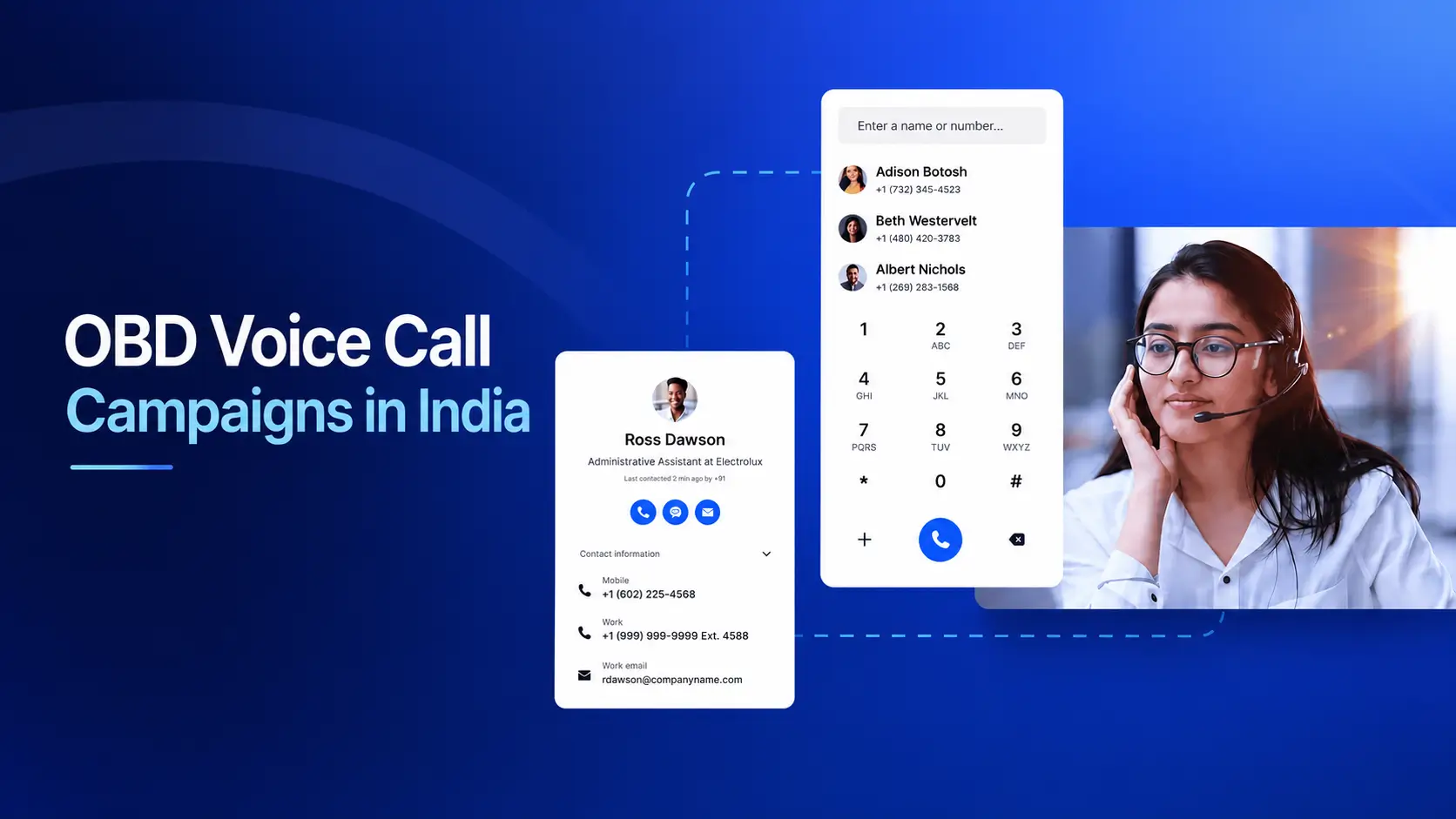
Outbound Dialer (OBD) voice calling is a system that automatically calls thousands of phone numbers. When someone answers, they hear a recorded message or a computer-generated voice. There is usually no person on the call unless the listener presses a button to speak to an agent. It's a one-way conversation, and that's fine. Most of the time, that's exactly what's needed.
Why has this taken off in India specifically? Cost, mostly. And simplicity. You don't need a call center full of agents to remind a hundred thousand people that their EMI is due. You need one recorded message and a dialer that knows how to run through a list.
That's why you see it everywhere once you start paying attention. At its core, this is Automated Voice Messaging. A business records one message, uploads a contact list, and the system handles the rest. The more advanced version of this, Voice Broadcasting Software, adds scheduling, DTMF response tracking, and language routing on top of the basic call and play function, which is what turns a one time broadcast into something you can run every week without extra manual work.
Banks use it for EMI reminders, since nobody wants to chase down a missed payment, so a quick call before the due date solves the problem before it exists. Hospitals use it to confirm appointments, because an empty slot is wasted money and a missed patient is a missed opportunity to help someone. Political parties use it to get messages in front of voters at scale. Love it or hate it, it works, which is why it hasn't gone away. And online shopping companies lean on it constantly, whether that's an OTP for a login or a heads-up that a package is on the way.
Here's the part that makes it more than just a broadcast tool, though: it tracks what happened. Who picked up. Who pressed the button to talk to someone. Who never answered at all. That data turns a mass phone call into an actual campaign, something a business can measure, refine, and run again smarter next time.
| The Customer's Moment | What's Happening for the Business | The Bigger Payoff |
|---|---|---|
| Gets a reminder before a bill, recharge, or renewal is due. | On-time payment collection and less time chasing customers. | Predictable revenue and fewer customers lost because they forgot to renew. |
| Hears about a delivery, appointment, or service change before it happens. | Receives fewer "What's happening?" support calls. | Lower support costs and faster customer service. |
| Doesn't miss an appointment or booking. | Has fewer no-shows and makes better use of staff and resources. | More bookings and higher revenue without adding extra resources. |
| Feels cared for because the company reminds them before a problem happens. | Building trust and long-term relationships with customers. | Loyal customers who return and recommend the business to others. |
| Receives messages in their language. | Reaches more customers across different cities and regions. | Faster business growth and a wider customer base. |
| Gets the information they need without calling customer support. | Staff spend less time answering the same questions again and again. | Employees can focus on high-priority work and save time and money. |
| Renews a service on time because they received a reminder. | Retains more customers and reduces service cancellations. | More repeat business and steady long-term income. |
| Knows exactly what to do next without confusion. | Builds a reputation for being helpful and reliable. | A trusted brand that customers choose, even when competitors offer lower prices. |
Well, if you are like Ohh!! I am a cafe owner, I don't need it. So here is the math.
If we see the current demographics, people are busy; they make plans after midnight. Imagine two friends wanted to visit your restaurant, and they are planning all this at 2 a.m., and they have to make a call for a next-day reservation.
What will they do?
Wait till tomorrow?
Well, the truth is they will not, they will call at 3 a.m to another cafe, the call will be picked up, and on the other side a robotic sound will confirm their reservation once they have pressed 1 2 3 buttons from their keypad.
Again, if you are thinking you just lost one customer. Let this be a reminder that those two people will tell this story to 5 other people, and they will post the story and tag the place on their social media. The calculation now gets easy.
Question is - What else do you lose to your competitor?
The answer is - Making the life of your customer easy, for which they love to pay.
If this has not convinced you, then this situation might be.
A local store that sells sarees. On a festive occasion, you decided to give all types of offers.
What will happen if people aren't aware of the discount you are giving?
You can make a call. Even to the customer who visited one time only.
But it gonna cost me a lot of money.
You were already ready to spend money on billboard advertising and radio advertising.
All you did was instead of entertaining a big crowd, you niche down to only those in the crowd who have been your customer.
Balancing the trade-off is easy.
Don't let your competitor be the one who calls back first.
Start your first OBD campaign with MetaReach — most businesses go live within 24–48 hours.
Types of OBD voice calling
| Type of OBD Voice Call | What It Does | Example | Who Uses It? |
|---|---|---|---|
| Reminder Calls | Reminds customers before they forget something important. | Recharge reminder, EMI reminder, insurance renewal reminder, appointment reminder | Telecom companies, banks, hospitals, insurance companies, gyms |
| Notification Calls | Shares important updates or changes. | Delivery update, flight delay, order confirmation, service outage notice | E-commerce companies, airlines, courier companies, utility providers |
| Confirmation & Verification Calls | Confirms a booking, payment, or customer action. | Booking confirmation, KYC verification, payment confirmation | Banks, travel companies, e-commerce businesses |
| Promotional Calls | Tells customers about offers, discounts, events, or new products. | Festival sale, café weekend offer, new product launch | Retail stores, restaurants, salons, gyms, supermarkets |
| Feedback & Survey Calls | Collects customer ratings and opinions to improve services. | "Rate our service from 1 to 5." or "Tell us about your experience." | Hotels, hospitals, restaurants, telecom companies, research firms |
| Emergency & Public Awareness Calls | Shares urgent alerts or important public information. | Weather warning, vaccination campaign, election reminder | Government departments, schools, NGOs, utility companies |
| Category | Types Included | Goal |
|---|---|---|
| Customer Service OBD Calls | Reminder, Payment Reminder, Renewal Reminder, Notification, Appointment Confirmation | Help customers and improve their experience. |
| Marketing OBD Calls | Promotional Calls | Increase sales, bring back old customers, and share offers. |
| Information OBD Calls | Feedback, Survey, Verification, Emergency & Public Awareness | Collect information or share important updates. |
Which businesses can use OBD voice calls?
| Business Type | Best OBD Voice Calls to Use |
|---|---|
| Banks & NBFCs | Payment reminders, EMI reminders, verification, promotional offers |
| Telecom Companies | Recharge reminders, plan renewal reminders, service notifications |
| Hospitals & Clinics | Appointment reminders, feedback calls, health awareness calls |
| Restaurants & Cafés | Promotional offers, event invitations, feedback calls |
| Retail & Clothing Stores | Festive sale promotions, loyalty offers, customer feedback |
| Salons & Spas | Appointment reminders, membership renewals, special offers |
| Gyms & Fitness Centers | Membership renewal reminders, promotional offers, class reminders |
| Schools & Colleges | Fee reminders, event notifications, holiday announcements |
| Travel & Hotels | Booking confirmations, travel updates, promotional packages |
| E-commerce & Courier Companies | Order updates, delivery notifications, customer feedback |
| Automobile Service Centers | Service reminders, booking confirmations, feedback calls |
| Utility Companies | Bill reminders, maintenance alerts, outage notifications |
| Insurance Companies | Premium reminders, policy renewals, claim updates |
| Real Estate Companies | Site visit reminders, project launch announcements, promotional campaigns |
| Government & NGOs | Public awareness campaigns, emergency alerts, election reminders |
For banks and NBFCs specifically, Payment Reminders OBD calls remain the single highest volume use case in this space. A recharge reminder and an EMI reminder both follow the same logic. Reach the customer before the deadline, not after the penalty.
Quick Guide: Which Type Should You Choose?
| Your Goal | Use This Type of OBD Voice Call |
|---|---|
| Increase sales | Promotional Calls |
| Bring back old customers | Promotional Calls |
| Reduce missed payments | Payment Reminder Calls |
| Increase renewals | Renewal Reminder Calls |
| Reduce no-shows | Appointment Reminder Calls |
| Keep customers informed | Notification Calls |
| Collect customer reviews | Feedback Calls |
| Understand customer needs | Survey Calls |
| Confirm bookings | Verification or Booking Confirmation Calls |
| Share urgent news | Emergency & Alert Calls |
| Educate the public | Public Awareness Calls |
The Rules for OBD Calling in India (2025): TCCCPR 2018 and the 2025 Amendment
Considering you want to use OBD (Outbound Dialing) for your business. Then some rules needed to be followed.
These rules come from TRAI's Telecom Commercial Communications Customer Preference Regulations (TCCCPR) 2018. In February 2025, TRAI made the rules stricter to reduce spam calls and protect customers.
- Tell Your Telecom Provider Before You Start - You have to inform your telecom provider, along with the reason why you are using it
- Know the Different Types of Calls - As discussed above, every business call is going to be different
| Type of OBD Voice Call | What Is It? | Common Examples | Important Rule |
|---|---|---|---|
| Transactional Calls | These calls happen after a customer takes an action or completes a transaction. They share important information related to that action. | OTP verification, Payment confirmation, Booking confirmation, Order confirmation | These calls cannot contain advertisements, discounts, or promotional messages. |
| Service Calls | These calls help existing customers by giving useful updates or reminders. | Appointment reminders, Delivery updates, Recharge reminders, EMI reminders, Service outage notifications, Renewal reminders | These calls should only share useful service-related information and should not be used for marketing. |
| Promotional Calls | These calls are used to promote products, services, offers, or events to increase sales. | Product offers, Festival sales, Discount announcements, New product launches, Event invitations, Membership offers | Businesses must have the customer's clear consent before making these calls, as required under India's telecom regulations. |
| Government Calls | These are official calls made by government departments or authorized agencies to share important public information. | Election reminders, Disaster warnings, Public health campaigns, Vaccination drives, Emergency alerts | These calls are meant for public interest and generally cannot be blocked by customers. |
Important: If you add even one sales message to a service or transactional call, the whole call becomes a promotional call. Different rules will apply.
- Use the Right Phone Number - TRAI now requires businesses to use approved number series.
| Number Series | Used For |
|---|---|
| 140 | Promotional and marketing calls |
| 1600 | Transactional and service calls |
Do not use the 1600 series to sell products.
Doing so can lead to blocked calls and penalties.
- Spam Rules Are Now Much Stricter - TRAI can now take action much faster. If enough people complain about your calls, Your numbers can be blocked; Your telecom service can be suspended; Repeat offenders can be blacklisted for up to one year.
- Spam-Blocking Apps Cannot Block Official Business Numbers - Apps like Truecaller cannot block every approved business number by default. This helps genuine businesses reach their customers while still fighting spam.
- Telecom Companies Now Use AI - Telecom operators now use AI and machine learning to find spam callers. They also work together to detect fake SIM cards and illegal calling systems. This makes it much harder for scammers to hide.
Extra Rules for Banks and Financial Companies
On 17 January 2025, the RBI issued Circular RBI/2024-25/105 — "Prevention of Financial Frauds Perpetrated Using Voice Calls and SMS" — for Regulated Entities (REs): banks, NBFCs, insurers, mutual funds, stockbrokers. It requires REs to:
- Register on the DLT platform under TCCCPR-2018 before sending any commercial voice call or SMS
- Use the 1600xx series for transactional/service calls and 140xx exclusively for promotional calls
- Use DoT's Mobile Number Revocation List (MNRL) via the Digital Intelligence Platform to clean customer databases
- Publish verified customer-care numbers on the Sanchar Saathi portal
- Educate customers — including in vernacular languages — about these changes
The compliance deadline was 31 March 2025; non-compliance can trigger action from RBI, IRDAI, SEBI, or PFRDA in addition to TRAI's network-level penalties. If you're a financial services business, this isn't optional — it determines which number series and which vendor capabilities you need from day one.
Consent Rules That Affect How You Run Campaigns
- Inferred consent is valid only for the duration of the customer contract, and must be clearly inferable from the registered content template.
- Explicit consent for service calls tied to completing a transaction expires after seven days.
- Promotional calls with properly captured explicit digital consent (via TRAI's Digital Consent Acquisition framework) can bypass a customer's "block promotional" preference.
- Customers who revoke consent can only be re-approached after a 90-day cooling-off period.
Any solution you pick needs to check DLT preferences and consent status automatically before dialing — manual list scrubbing is not sustainable at scale and increases your compliance risk.
What This Means for Your Business
A good OBD provider should automatically:
- Check customer consent.
- Check DLT preferences.
- Use the correct phone number series.
- Follow the latest TRAI rules.
Doing this manually becomes difficult as your business grows. A compliant OBD platform saves time and reduces the risk of penalties.
Let a TRAI-compliant, DLT-registered platform carry the compliance weight for you.
Talk to MetaReach Marketing — 10+ years running compliant campaigns for 500+ Indian businesses.
Common Terms You Will See When Opting for OBD (Explained Simply)
| Term | What It Means (Simple English) |
|---|---|
| API (Application Programming Interface) | A bridge that connects two software programs. For example, when a customer books an appointment, the booking system automatically tells the OBD system to make a reminder call. |
| DTMF (Dual-Tone Multi-Frequency) | The buttons you press during a phone call. For example, "Press 1 to confirm your appointment. Press 2 to cancel." See our DTMF service for setup details. |
| IVR (Interactive Voice Response) | An automated phone system that speaks to customers and responds when they press keypad buttons or give voice commands. |
| CPaaS (Communication Platform as a Service) | A cloud-based platform that lets businesses use voice calls, SMS, WhatsApp, email, and other communication channels from one system. |
IVR Integration and a Cloud Communication CPaaS setup are usually what separates a business running a handful of one off campaigns from one running Interactive Voice Response at scale across multiple channels from a single dashboard.
Choosing the Right OBD
This is usually what people mean when they ask about the best outbound dialer for enterprises. Not the cheapest option, but the one whose APIs, webhook support, and CRM sync can actually keep up with call volume as the business grows.
| Type of OBD Provider | What Does It Mean? | Best For | Simple Example |
|---|---|---|---|
| Developer-Friendly Platform | A platform that lets your website, app, or CRM automatically start voice calls without human work. It connects with your business software using APIs (a way for two software programs to talk to each other). | Large companies with an IT or software team. | A bank automatically calls customers whose EMI is due tomorrow. |
| All-in-One Communication Platform | A platform that manages SMS, WhatsApp, Email, and Voice Calls from one dashboard. You don't need different tools for each channel. | Small and medium businesses that want everything in one place. | A hospital sends an appointment reminder through SMS and an OBD voice call using the same platform. |
| Managed OBD Service | The provider handles everything for you — from recording the voice message to calling customers and sharing reports. You don't need technical knowledge. | Businesses without an IT team. | A real estate company asks the provider to call 20,000 people about a new project launch. |
That same logic applies just as well to voice broadcast for lead generation outside real estate. A gym announcing a new membership slot, a car dealership calling past inquiries before a festive sale, a school reminding parents about an open house. The channel does not care what the offer is. It only cares whether the list is clean and the message is short enough to hold attention in the first ten seconds.
Which One Should You Choose?
| If You… | Choose This | Why? |
|---|---|---|
| Have an IT or software team | Developer-Friendly Platform | It can connect directly with your business software and automate voice calls. |
| Want SMS, WhatsApp, and Voice Calls together | All-in-One Communication Platform | Everything is managed from one place. |
| Don't have a technical team | Managed OBD Service | The provider handles the entire campaign for you. |
Pros and cons of OBD voice calling as a channel
Pros:
- Extremely cost-effective per contact compared to live agent calling — often cited at roughly a tenth of the cost
- Reaches non-smartphone and low-data users, and works well in regional languages — a real advantage over app/SMS-only channels in rural and older demographics
- Scales to millions of calls in a short window without proportional headcount
- DTMF and press-1 features let you qualify leads or route interested customers to a live agent without losing the human touchpoint entirely
- Real-time analytics (answer rate, DTMF breakdown, transfer rate) make it easy to measure and iterate
Cons:
- Heavily regulated — get the number series, consent, or content category wrong and your telecom resources can be suspended within days
- Answer rates for cold/promotional OBD calls are generally lower than for SMS or WhatsApp, and declining as consumers grow wary of unknown numbers
- Poor targeting or high complaint volume can now trigger fast enforcement action under the 2025 amendment (five complaints in ten days can start an investigation)
- Less personal than a live agent call — not ideal for high-value, relationship-driven conversations (e.g., wealth management, enterprise sales)
- Requires ongoing DLT/DND list hygiene — a "set and forget" contact list will accumulate compliance risk over time
Worried about getting the number series or consent rules wrong?
MetaReach's platform checks DLT and consent status automatically before every call — get a free compliance walkthrough and see it for yourself.
How OBD compares to other business phone solutions
| Channel | Best for | Limitation |
|---|---|---|
| OBD voice broadcast | Mass reminders, alerts, surveys, low-cost outreach at scale | Regulatory complexity; lower engagement than 1:1 channels |
| Live agent calling (call center/BPO) | High-value conversions, complex queries, relationship building | Expensive, doesn't scale to millions quickly |
| Cloud IVR / voice OTP | Inbound support, authentication, self-service menus | Not designed for proactive mass outreach |
| Bulk SMS / WhatsApp Business API | Digitally engaged, smartphone-using audiences; rich media, links, buttons | Excludes feature-phone/rural users who OBD can still reach; also under its own DLT rules |
| RCS messaging | Branded, media-rich messaging for younger, urban audiences | Limited reach outside RCS-enabled devices/carriers |
In practice, most mature businesses in India don't pick a single channel — they run OBD alongside SMS and WhatsApp, using voice for reminders/alerts that need to reach the widest possible audience (including non-smartphone users) and reserving live agents for high-stakes conversations.
Practical Steps to Run a Compliant OBD Campaign
If you are still working out how to use voice OBD for marketing without running into TRAI penalties, these are the nine steps that matter, in the order they matter.
- Register as a Sender/Principal Entity on the DLT platform through your telecom access provider, or route calls through a Registered Telemarketer (RTM).
- Register your content templates and headers — every message must match a pre-approved template; at least 30% of content must be fixed.
- Pick the correct number series — 140 for promotional, 1600 for transactional/service if you're a regulated financial entity.
- Pre-declare auto-dialer use to your Originating Access Provider before launch.
- Scrub your contact list against DND/preference and Consent Registers before every send — ideally automated by your provider, not manual.
- Capture and log explicit consent through the DCA platform wherever required.
- Keep content matched to category — don't mix promotional messaging into a transactional/service call.
- Watch complaint volumes — five complaints from unique recipients within ten days can trigger an automatic investigation.
- Evaluate vendors on compliance tooling, not just price — DND filtering, consent logging, and calling-window enforcement should be built into the platform, not something you bolt on yourself.
Picture this list already done for you — registration, templates, number series, DND scrubbing, all handled.
Set up your compliant OBD campaign with MetaReach and skip straight to the calls that actually reach people.
Where This Leaves You
Let's land the plane.
OBD is still one of the best deals in Indian business communication. Cheap, wide reach, nothing else really competes on those two measures at once. But 2026 isn't 2020. The TCCCPR amendment and RBI's new fraud-prevention rules changed the game, and the businesses winning with OBD right now aren't the ones who found a cheap vendor and called it done. They're the ones who built DLT registration, number-series selection, and consent management into the campaign from day one, not bolted on after a warning letter.
So how do you actually choose a provider? It depends on who you are.
If you're a regulated financial player, a bank, NBFC, insurer, or broker, this isn't a "nice-to-have" conversation. Go with a provider that has mature 1600/140 series support, real MNRL integration, and DLT compliance documentation they can actually show you. That's not optional. That's the price of entry.
If you're running a high-volume, tech-led business, e-commerce, fintech, SaaS, and you want programmatic control, look for an API-first CPaaS platform. Webhook support, CRM sync, the ability to trigger calls straight from your own application logic. You want the system talking to your system, not a human copying lists back and forth.
If you're already sending SMS or WhatsApp through one vendor, consider consolidating. A multi-channel provider that handles OBD alongside what you're already using means one dashboard, one bill, one compliance headache instead of three.
If you're running political campaigns, or you're a school, hospital, or real estate developer with seasonal, one-off campaigns, a self-serve API probably isn't your best fit. You're better off with a managed agency, one with strong regional-language TTS, city-level support, and someone actually walking you through onboarding instead of leaving you to figure it out.
And no matter who you are, check for three things before you sign anything: DND scrubbing, DCA-based consent capture, and calling-window enforcement. These aren't checkbox features. They're the difference between a campaign that runs smoothly and one that gets your resources suspended halfway through.
Here's the bigger point, though. OBD was never meant to carry the whole relationship by itself. It's one piece of a bigger communication stack, strong on reach, strong on cost, but it does its best work paired with SMS, WhatsApp, and a live agent standing by for the conversations that actually need a human on the line.
This article is for informational purposes and reflects TRAI and RBI regulations as of mid-2026, along with publicly available information from OBD service providers. Businesses should consult current TCCCPR regulations, RBI circulars, their telecom access provider's Code of Practice, and individual vendor documentation before launching a campaign or signing a contract.
There is a very thin line between
"They're helping me."
"They're pressuring me."
When it becomes repetitive or promotional, the same technology shifts from being perceived as helpful to being perceived as harassment. The success of an OBD campaign isn't measured by the number of calls made; it's measured by whether customers feel the call added value to their day rather than taking time away from it.
That's the OBD landscape in 2026 — and now you know it better than most vendors calling you.
When you're ready to actually run a campaign, book a free demo with MetaReach Marketing or message their team on WhatsApp — trusted by 500+ Indian businesses and built compliance-first from day one.